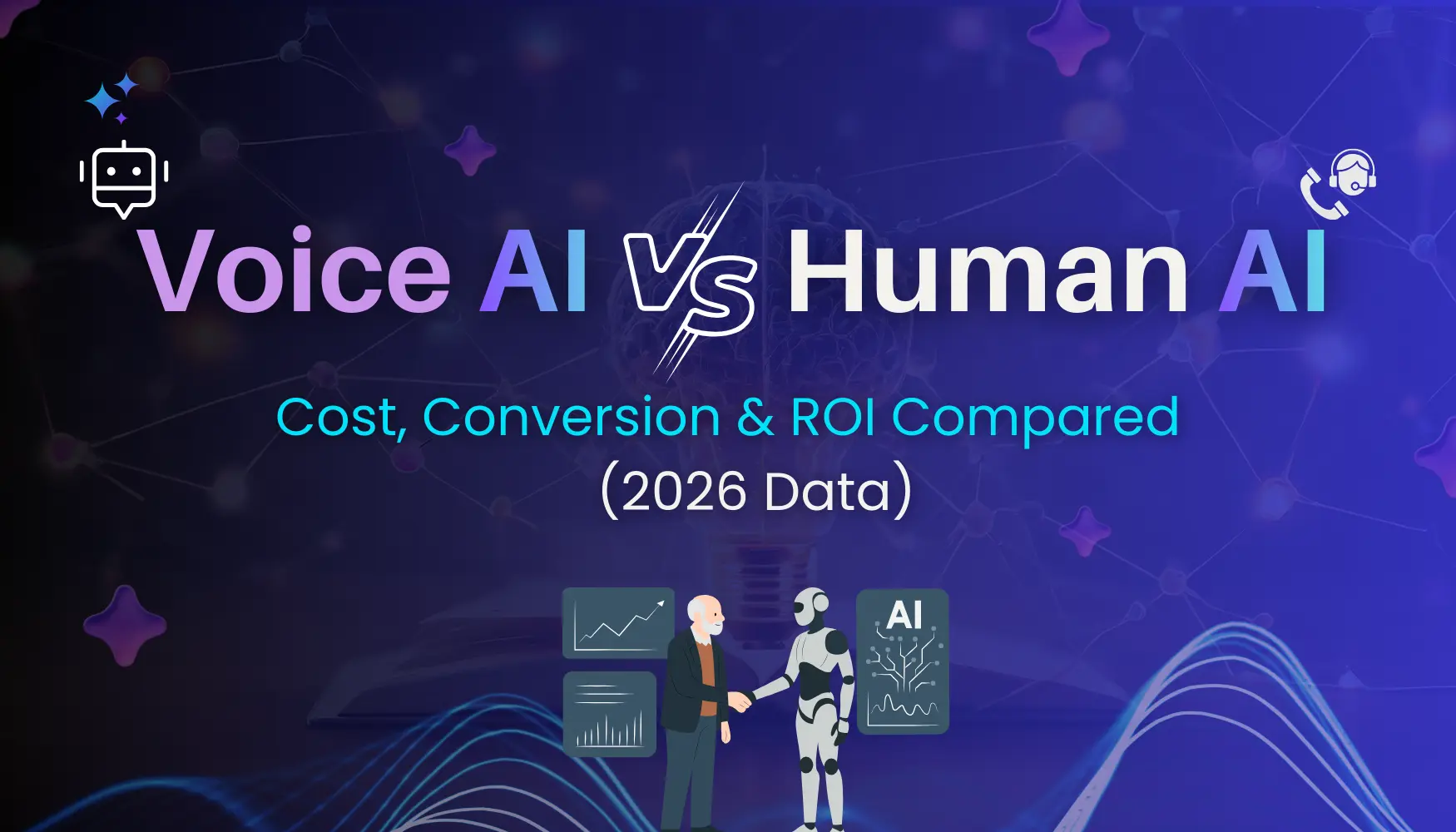
Voice AI vs Human Call Agents: Compare costs, conversion rates, scalability, and ROI. Learn how AI-powered calling improves efficiency, reduces expenses, and drives business growth.
- 1Integrate Voice AI to reduce operational costs by automating routine customer interactions, freeing up human agents for complex issues.
- 2Leverage Voice AI to increase conversion rates through 24/7 availability and personalized, data-driven interactions.
- 3Measure and track ROI by comparing cost savings and revenue increases from Voice AI implementation against its investment.
- 4Prepare for the future by understanding that by 2026, Voice AI will be a critical component for businesses seeking competitive advantage.
- 5Optimize human agent roles to focus on higher-value tasks and emotional intelligence that Voice AI cannot replicate.
Voice AI vs Human Agents: Cost, Conversion, and ROI in 2026
Customers are the life and blood of every organization, and to remain relevant businesses must offer consistent efforts to provide them with faster and cost-effective support. In fact, they are under tremendous pressure crank up efficiency and cut costs. With AI transforming the way how businesses conduct themselves, the obvious question that pops up is whether AI-enabled phone calls can outdo human call agents. The answer is a sure shot yes!
Today, AI calling automation is no longer a futuristic concept. Rather, it's a very practical and real solution that has helped companies qualify leads and close more deals while significantly expanding their reach—all while keeping costs under control. This article draws a comparison between AI vs Human agent and the impact on revenue thereof.
For businesses handling high call volume, switching to voice AI is the way to go. Besides the dramatic cost difference, the trade-offs in customer experience, and implementation complexity is remarkable.
All You Require Knowing About Voice AI?
Traditional models are plagued by rising costs, undependable service quality, and limited scalability. This has left multiple businesses searching for better solutions. And this is where Voice AI agents are transforming the landscape.
These voice assistants are capable of comprehending natural language, replying empathetically and fixing customer issues in real time aren’t just augmenting efficiency, they are redefining the customer experience itself.
AI voice agents are software-driven that use voice recognition, natural language processing (NLP), and machine learning to provide human-like interactions. Designed to interact certainly with users, these tasks complete tasks, and carry out intricate operations. These agents can reply to questions, assess behavior of customers, and tailor interactions based on previous conversations. Common examples include virtual service agents, voice AI assistants, and automatic communication systems.
Voice AI vs Human Agent: Cost Comparison
| Cost Factor | Human Agents | Voice AI |
|---|---|---|
| Labor Costs | Hiring, training, benefits, salaries, office space, attrition and reskilling expenses. | Subscription-based pricing with minimal incremental call handling costs. |
| Training & Onboarding | Continuous onboarding, product training, skill development, and refreshers. | Initial setup and domain-specific training with low ongoing maintenance. |
| Operational Scalability | Costs increase with call volume and staffing requirements. | Handles spikes in demand with minimal additional operational cost. |
Labor Costs
Human agents bring along considerable ongoing expenses, including hiring, training, benefits, salaries, office space, along with the cost of attrition and reskilling, with fully loaded annual costs per agent in developed markets. Voice AI, on the other hand, is priced based on subscription. Once deployed, the incremental cost of handling each additional call is minimal. There are no payroll costs, paid time off, or downtime — only telephony costs. Consequently, Voice AI delivers significantly lower operating costs than traditional human-staffed call centers.
Training & Onboarding Costs
While human agents require unceasing onboarding, development of skills, product training, and periodic refreshers—especially in regulated industries. High income only increases these expenses, compelling organizations to recurrently invest in hiring and retraining. Voice AI requires a direct configuration and domain-specific training, but this is largely a low-maintenance effort. Once trained, it scales and adapts quickly, and doesn’t need repeated retraining every time employment changes, making it much more cost-efficient over time.
Operational Scalability
With human agents, costs rise is directly proportion to call volume, as higher demand requires increased hiring, or outsourcing to keep up. On the contrary, Voice AI scales beyond limits—handling spikes in volume with reduced additional cost. Expanding capacity for seasonal rushes is way more efficient than training, recruitment and handling additional staff, making Voice AI a more scalable operating model.
Conversion Performance: Who Delivers Optimum Results?
Conversion isn’t just about taking calls—it’s about supervising customers toward a desired outcome. Whether that’s making a purchase, appointment booking, qualifying a lead, or fixing an issue.
Speed & Availability
Human team function within fixed shifts and limited staff. This translates to wait times, missed calls, and missed opportunities especially during peak times. Voice AI is obtainable round the clock, without any delay or fatigue. It can manage thousands of discussions simultaneously. This eliminates hold times and ensures every caller is catered to instantly.
Impact on Conversion: Since customers value faster responses, which lead to higher engagement and better completion rates.
Comparing ROI: Who Emerges as the Clear Winner?
When comparing Voice AI ROI with human agents, it’s crucial to look ahead of cost reduction to w.r.t overall business impact, including customer satisfaction, revenue, retention, and operational efficiency. That said, Voice AI delivers strong returns through cost savings alone. By removing labor expenses, shift premiums, and ongoing attrition costs, organizations can reduce the cost of managing high-volume, redundant calls. Consequently, many organizations see payback in months rather than years when they replace traditional call handling with Voice AI.
ROI from Conversion Lift
Voice AI offers greater returns by fortifying core conversion metrics, such as higher completion rates through round-the-clock availability, lower abandonment, and quicker resolution times. When embedded into workflows, AI removes resistance from the customer journey and ensures follow-ups happen quickly. This drives more conversions, deal closure, and sturdier overall performance.
ROI from Data & Insights
Human agents usually record call records manually, which often leads to incomplete, unpredictable, or lost data. Voice AI, on the other hand, captures, assemblies, and analyzes every conversation by default - giving companies usable insights. This reduces the time reps spend revising calls, recovers forecasting precision, and allows real-time optimization across teams. Consequently, conversation data becomes a deliberate asset that drives intelligent decisions, rather than any other operational cost.
Final Words
Voice AI is isn’t just a technology—it is a strategic platform that reshapes how businesses connect with customers by reducing costs, hastening conversions, improving data quality, and augmenting the overall customer experience when employed effectively.
The future isn’t about replacing humans with AI. Rather, it’s about AI working together with them, with the strongest organizations using Voice AI to amplify human capabilities rather than eliminating them.
For any sales team handling a humongous volume of voice interactions, now is the right time to explore how Voice AI can offer tangible returns across conversion performance, cost efficiency and long-term customer loyalty.