AI voice agents are transforming customer interactions by automatically updating Salesforce during live calls. Discover how real-time transcription, intent recognition, and CRM automation improve data accuracy, agent productivity, and customer experiences.
- 1Automate Salesforce updates during live customer calls with AI voice agents to improve data accuracy and agent efficiency.
- 2Leverage AI voice agents to understand customer intent and sentiment in real-time, going beyond simple transcription.
- 3Integrate AI voice agents with Salesforce to automatically log call details, create follow-up tasks, and trigger workflows.
- 4Reduce manual data entry and free up sales and service agents to focus on customer engagement by automating routine tasks.
- 5Implement AI voice solutions that use Advanced Speech Recognition (ASR) and Natural Language Understanding (NLU) to process and interpret spoken conversations.
How AI Voice Agents Automatically Update Salesforce During Live Customer Calls?
The business landscape has evolved significantly over the years and so has the expectations of the customers. Customers no longer have the patience to wait and get their queries resolved.
Businesses are expected to offer prompt, precise and tailored responses to customer queries – failing which clients prefer looking for other options. One such scenario where teams are under tremendous pressure includes the sales and service teams that must deal with growing call volumes while maintaining detailed client records within Salesforce.
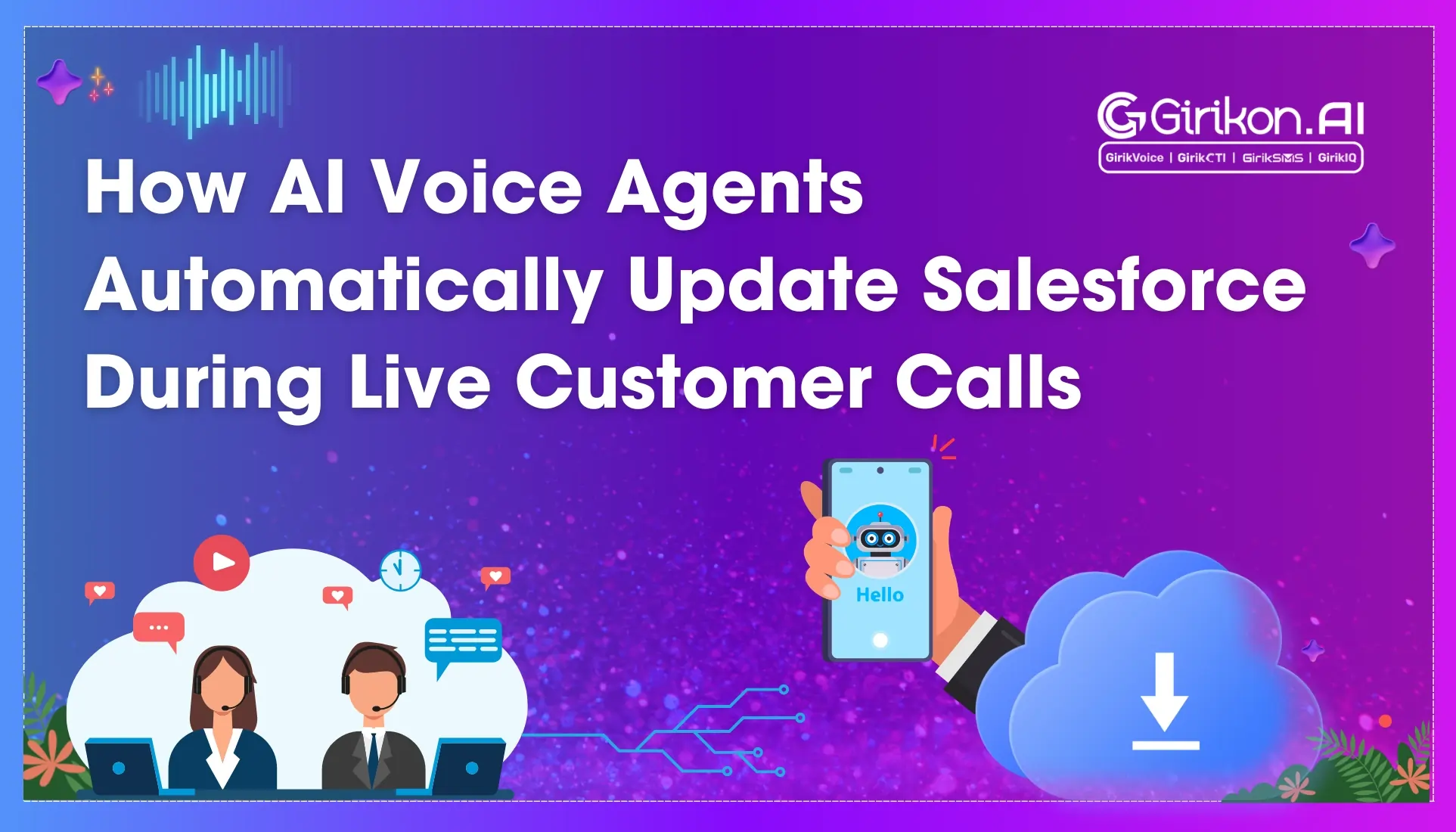
Now, updating Salesforce during or after client interactions, that too manually, not only reduces productivity but also raises the risk of incomplete or imprecise CRM data. This process is now being transformed by AI voice agents through advanced Salesforce AI call automation. Organizations can capture client interactions by default, draw crucial information, and update Salesforce records in real time during live interactions.
This integration of Voice AI and CRM technology is empowering businesses to optimize agent efficiency, augment customer experiences, and maintain precise customer data.
What are the Challenges Faced by Businesses While Updating Salesforce Updates Manually?
The ongoing challenge of managing Salesforce updates together with their customer interactions has been rife for years with client service reps and sales agents struggling to deal with this challenge. In a typical call, agents usually open relevant Salesforce records, gather client details, document call summaries, update cases, create follow-up activities, schedule future actions, and allocate tasks to other departments. Though these tasks are crucial for maintaining precise CRM data, they eat away a significant part of an agent's workday – minimizing the time available for significant customer engagement.
Studies conducted reveal that client-facing employees spend a significant amount of time on routine tasks rather than interacting with customers. As organizations grow, these inefficiencies become more noticeable - leading to incomplete call notes, slow CRM updates, unpredictable data entry practices, human mistakes, decreased productivity, and limited visibility into client interactions. To fix these challenges, businesses are adopting modern AI voice Salesforce integration solutions that besides automating CRM updates also streamline customer interaction management.
All You Require Knowing About AI Voice Agents?
They are smart interaction systems that comprehend, process, and respond to spoken language in real time. By leveraging technologies such as Large Language Models (LLMs), AI-powered communication system, and more, these systems interact like humans and easily interpret client intent.
Conventional IVR systems depend on fixed menu and predefined responses. However, modern Salesforce AI solutions can comprehend context, maintain easy flow of dialogue, and adjust to the needs of clients. This allows organizations to deliver more efficient, seamless and tailored client experiences through voice discussions.
When amalgamated with Salesforce, AI voice agents grow into powerful assistants that do more than give reply to calls. They can consolidate details about customers, update CRM records, log call details, create continuation tasks, and trigger workflows in real time. This seamless AI voice Salesforce integration empowers businesses to improve data precision, streamline processes, and minimize the routine tasks on client-facing teams.
How AI Voice Agents Update Salesforce During Live Calls?
For AI voice agents to update Salesforce during client interactions, multiple layers of intelligence must work in association with each other in real time. From comprehending spoken language to completing CRM actions, these systems assess and process data as the discussion unfolds.
Step 1: Capturing and Transcribing Customer Conversations
The process starts as soon as a customer begins speaking. Technologies such as ASR (Advanced speech recognition) can listen to discussions and convert spoken words into appropriate text must be leveraged, even in complex environments with different accents and interaction styles. For instance, if a customer says, “I wish to update my shipping address and see my order status,” the system transcribes the request immediately.
Step 2: Understanding Intent
Once the interaction is translated into text, the AI engine uses Natural Language Understanding to recognize the context behind the conversation and determine client intent. Besides evaluating the conversation for client intent, it also assesses sentiment, context, and other actions that must be executed. This allows the system to move beyond easy transcription and gain a detailed understanding of the client’s request.
Step 3: Retrieving Relevant Salesforce Records
After understanding the intent, the AI voice agent integrates with Salesforce through APIs to find the right customer record in real time. Using details such as a phone number, client ID, email address, or account number, the system retrieves appropriate Salesforce data. This includes contact details, opportunities, open cases, service history, previous interactions and orders. This urgent access to customer information allows Salesforce Voice AI agents to offer tailored and context-aware interactions while maintaining a detailed view of the client’s journey across every point of contact.
Step 4: CRM Updates
One of the significant benefits of Salesforce AI call automation is its facility to update CRM records by default during live chats. As customers request new changes, the AI CRM automation voice agent captures details and updates the Salesforce fields in real time. This does away with the need for manual data entry - ensuring records remain precise and up to date. This enables businesses to maintain a trustworthy source of information without burdening the agents with additional administrative tasks.
What Does the Future Hold for Salesforce Voice AI Automation?
The future of client engagement is being shaped by smart automation. As Large Language Models continue to evolve, AI voice agents will become increasingly smart in understanding complex interactions, anticipating client needs, performing multi-step processes, tailoring interactions, and automating CRM processes. Rather than just capturing notes or updating records, these systems will evolve into customer engagement assistants by default. Organizations that adopt Salesforce AI call automation early will gain an edge through greater efficiency, lower costs, and augmented customer experiences.
Final Words:
Manual CRM updates done in the traditional way have decreased the productivity of sales and customer service teams. The integration of Voice AI and Salesforce has helped businesses capture conversations, generate call details, trigger workflows and more during live interactions. By amalgamating Salesforce voice AI, conversational AI Salesforce, and AI automation voice technologies, companies can optimize precision, eliminate redundant tasks, and transform every client conversation into actionable intelligence.