Voice AI is rapidly transforming customer interactions, but not every AI assistant is built for enterprise use. Discover the five capabilities that define an enterprise-ready Voice AI agent—from advanced language understanding and compliance readiness to seamless integrations, scalability, and performance analytics.
- 1Implement Natural Language Understanding (NLU) that focuses on intent and context, rather than just keyword matching, to enable natural conversations.
- 2Ensure voice AI agents are built with compliance and regulatory readiness from the outset to meet legal and industry standards.
- 3Integrate voice AI solutions seamlessly with existing enterprise systems (CRM, ERP, etc.) for real-time data access and workflow automation.
- 4Design voice AI solutions for scalability to handle significant increases in interaction volumes without performance degradation.
- 5Develop enterprise-ready voice AI agents that go beyond simple customer requests to retrieve information and execute approved business actions.
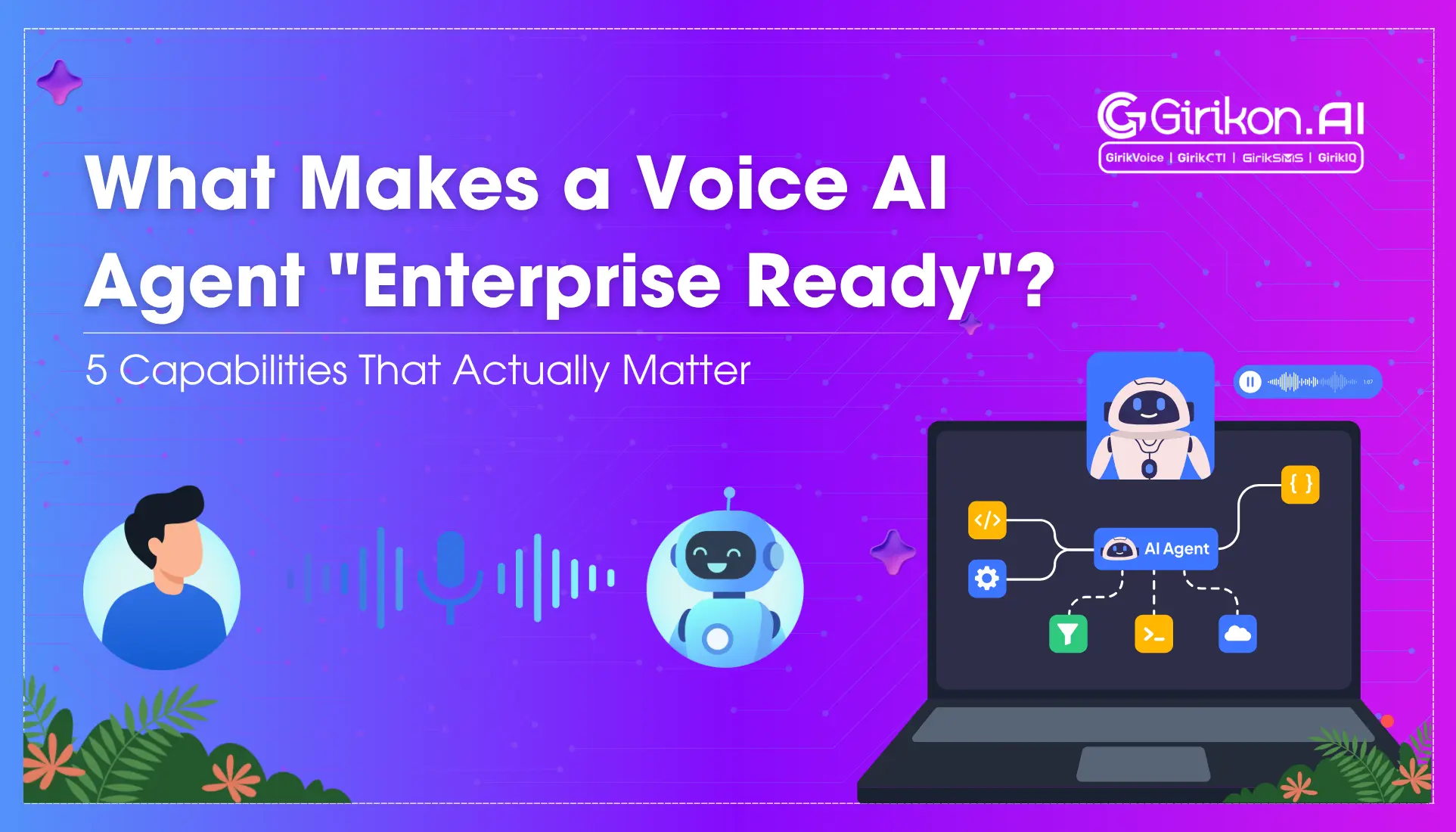
What Makes a Voice AI Agent "Enterprise Ready"? 5 Capabilities That Actually Matter
"Press 1 for sales. Press 2 for support. Press 3 for billing." Most of us have encountered these automated phone systems. The truth is most of them have aged pretty poorly.
They make users go through rigid menu navigation processes, fail to comprehend queries, and leave people frustrated before a human agent even joins the call.
A majority of people don't really care who they speak with, a human agent or an AI assistant; what matters is that their matter gets resolved the right way. Today's advanced AI voice assistants are promising superior experiences by allowing people to talk naturally and get assistance without delay. Indeed, developing an AI voice assistant that will be able to handle business operations will take much more effort than simply introducing AI in customer service. Given that enterprise voice automation is becoming a global priority, implementing only a conversational AI assistant will be insufficient.
Here, we'll examine the capabilities that make a voice AI agent truly enterprise-ready.
Understanding Enterprise-Ready AI Voice Assistant and What Makes It Unique?
Despite the presence of several AI-powered voice assistants that will help the user to answer questions, schedule appointments, and provide guidance, this alone may not be enough for them to be enterprise-ready. Being enterprise-ready means that a voice assistant was designed to be implemented within the conditions of large enterprises, including functioning on many business processes, adhering to the operational standards, protecting confidential data, and performing consistently despite increasing interaction volumes. It must support actual business processes.
This is where the distinction becomes clear. A standard voice assistant focuses on responding to customer requests. An enterprise solution is designed to understand requests, retrieve information from connected systems, execute approved actions, and maintain governance throughout the interaction.
With organizations moving forward with enterprise voice automation projects, the standards have evolved somewhat. While the quality of interactions does matter, in certain cases, other features such as reliability, security, scalability, and controllability can be the key to achieving production success for an AI voice assistant.
Capabilities That Define an Enterprise-Ready AI Voice Agent
Although an AI voice assistant might seem intelligent enough when demonstrated, a different set of capabilities is required to succeed in real-world use cases. The capabilities below frequently define the difference between experiments and business-grade AI voice assistants.
1. Natural Language Understanding (Not Just Keyword Matching)
Most legacy voice systems are built around keyword detection. Mention billing, and you are routed to billing; say support, and the system follows a predefined path. The problem is that customers rarely communicate in such predictable ways.
An enterprise-grade voice agent is intent-oriented instead of being dependent on individual words. The agent recognizes the context and adapts to various changes in a conversation. This is critical for enterprise voice automation because the conversation should be natural and lead to the proper conclusion.
2. Compliance and Regulatory Readiness
Companies must be compliant with industry standards and laws. Depending on their geographic locations or areas of operation, companies have to meet the requirements of GDPR, HIPAA, PCI DSS, SOC 2, among other regulations.
Voice AI solutions for enterprises should be able to handle compliance pre-requisites such as consent for recording, compliance reporting, audit logging, etc. Good voice AI compliance capabilities can make an organization more secure and accountable. Rather than making compliance officers adapt to voice AI, an enterprise-level voice AI system is designed around the requirement from the start.
3. Seamless Integration with Enterprise Systems
An effective business result can be achieved only if the AI tool can integrate with the systems that your teams work with daily. These include CRM, contact center software, ticketing software, ERP applications, as well as internal databases.
If properly integrated into the solution, an enterprise conversational AI solution can get real-time information, make updates to the database of customer records, initiate support tickets, and workflows. For the customer, this means personalization. As for the business side, this reduces the workload and increases efficiency. The ability to integrate easily into an existing tech stack is one of the biggest enterprise readiness metrics.
4. Scalability Without Performance Bottlenecks
A voice AI solution might perform well with a few hundred calls per day. The real challenge is maintaining performance when call volumes increase dramatically. Enterprise environments often experience seasonal demand spikes, product launch surges, and thousands of other simultaneous conversations.
An enterprise-level solution should be scalable, without sacrificing the effectiveness and reliability of the responses. Furthermore, a scalable voice AI platform will comprise a cloud-based architecture, load balancing capabilities, and performance monitors, among others. Scalability is not just about handling more calls. This is all about keeping customer experiences constant irrespective of the volume of work.
Companies adopting voice AI technology at present require a solution that can grow with their future requirements without the need to change the entire system design.
5. Analytics, Monitoring, and Continuous Optimization
Business impact needs to be seen in AI applications in the enterprise sector. Without that, there won’t be any means of gauging the worthiness of the software. Advanced analytics proves to be useful in such situations because enterprise-grade solutions allow for analyzing call volumes, resolution statistics, customer behavior, average handling time, and other data.
For technical teams, these insights support model optimization and workflow enhancements. For business leaders, they provide evidence of return on investment (ROI). The most successful voice AI implementations are not static systems. They continuously evolve based on performance data and customer behavior.
Conclusion
Years back, the concern was about how realistic AI voice could sound. Today, however, the greater issue is how capable the AI is of working under business realities. Customers rarely notice the technology behind successful interactions. The customer will see whether their problem was solved efficiently and smoothly.
With advancements in enterprise call automation technologies, perhaps the future belongs not just to conversation but also to the ability of AI voice agents to act based on conversations.