AI prospecting tools can boost sales efficiency, but success comes from balancing automation with human interaction. Discover 5 practical tips.
- 1Leverage AI to accelerate research and identify buying signals, but always validate the information with human judgment to ensure relevance to the prospect's context.
- 2Personalize outreach beyond basic templates by using AI to uncover trends and company initiatives, then add a human touch to connect these insights to prospect needs.
- 3Implement clear human review checkpoints for AI-generated content and lead prioritization to maintain quality, accuracy, and brand consistency.
- 4Automate repetitive administrative tasks like lead qualifying and data enrichment, but ensure humans handle all direct conversations, objection handling, and relationship building.
- 5Measure the quality of sales conversations and engagement (e.g., response rates, meetings) rather than just activity metrics to gauge true effectiveness and build trust.
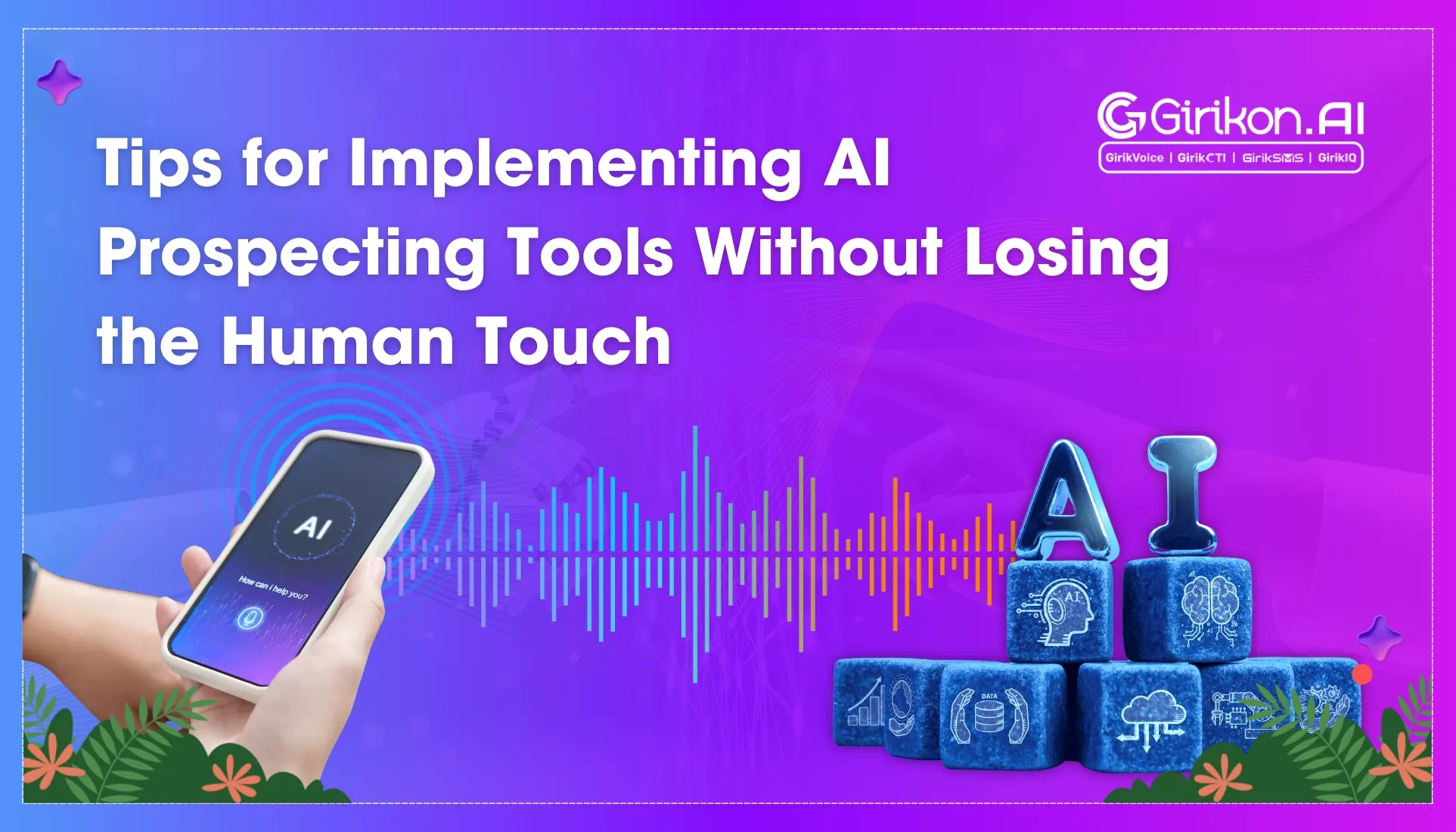
5 Tips for Implementing AI Prospecting Tools Without Losing the Human Touch
AI prospecting tools are truly a game-changer for the sales team yet choosing them with no human touch can sometimes create an unavoidable snag.
Sales teams no longer have to identify their prospects or manage the outreach manually - all thanks to "Artificial Intelligence." That means sales representatives don't have to invest their time doing repetitive tasks, which results in faster execution with steady stability.
Here is the catch: the excess use of AI might boost the sales team's productivity, but at what cost? Lacking the relatability or actual relevance. In most cases what happens is there are no conversations but just noises.
Do you know what successful sales teams do? They amalgamate both automation and human judgement while approaching the AI prospecting best practices. They treat AI as an assistant that manages the repetitive tasks, while sales representatives focus on increasing credibility.
Why Human Touch Still Matters in AI Prospecting
AI can surely identify when the user is at the buying stage, or analyze large datasets, and even send outreach messages within a few instructions. But what it lacks is no understanding of human emotions, actual meaning of business relationships, or even a slight context that might influence the user to make a purchase.
That is the main reason; organizations are inclining more towards the human-first AI outreach approach. A smart move would be letting AI alone manage the interaction with customers, seeking support for the repetitive tasks, while maintaining the human touch whenever it is required. For example, initiating human conversations, or fostering meaningful partnerships.
Understand that final goal is not about picking the right approach but balancing AI and human sales that will result in improved efficiency without losing the personalization touch. When used in a correct manner, AI can act as an assistant for the sales representatives while they focus more on selling.
Below are the AI prospecting best practices that not only boost efficiency but also bolster personalization along with the prospecting process that gives a human touch at every phase.
Use AI to Support Research Work
One of the effective AI prospecting best practices is leveraging the capabilities to speed up the sales representatives' research. With the help of AI tools, companies can collect information, identify buying signals, and come up with suitable insights much faster than manually.
But still, as a sales representative, ensure that whatever information you've processed is validated. One option might be to conduct a swift evaluation on whether it correlates with the prospect's business context, challenges, and needs. From the beginning alone, it already avoids false premises and enables the development of more relevant conversations.
Focus on Meaningful AI Sales Personalization
Personalization isn't about popping the prospect's name, company, and/or job title into a pre-written template.
Use AI to discover the latest trends in the industry, initiatives within the company, or some pain points. Once all gathered, add a human touch to connect the dots with the prospect's certain expectations. It helps in creating a strong engagement with every interaction feeling more real.
Define Clear Human Review Checkpoints
Don't fully rely on AI, and that is why a keen observation from the human end is needed. It maintains quality, accuracy, and brand consistency throughout the outreach campaign.
For instance, with the help of AI, sales representatives can draft an email, send follow-up messages, and prioritize leads after giving approval. This approach supports an AI sales automation strategy with the involvement of human judgment.
Enhance the Flow by Not Automating Every Conversation
Automation has its strongest value where it relieves you from the distress of manually performing certain mundane activities such as lead qualifying, enriching data, scheduling a meeting, or sending an email for a reminder.
All conversations, handling of objections and efforts to develop relationships must be carried out by a human. At the core of the AI SDR workflow optimization, philosophy is the elimination of administrative hard work and the facilitation of authentic human interaction across the entire sales process. This core philosophy aligns well with human-first AI outreach.
Measure Conversation Quality, Not Just Activity
There are teams that measure success based on the number of emails sent, calls completed or leads processed. These numbers can be useful, but they are not going to decide on the quality of partnership.
Monitor indicators of real engagement (response rate, meetings, level of conversation, opportunities created) and you’ll have a much better idea if your outreach is actually creating trust and real sales opportunities. Coupled with AI insight, this information allows for constant team improvement.
Common AI Prospecting Pitfalls to Avoid
If your team dodges the common pitfalls described above, your team will have no problem keeping personalization up, and engagement high.
- Using automation for every single interaction when human touch is most important.
- Sending AI-generated messages without proofreading for accuracy, tone, and context.
- Simple tokenization as a form of hyper-personalization.
- Focusing on high-volume outreach versus actual engagement with prospects.
- Ignoring the input of the sales team when setting up AI-powered processes.
Conclusion
AI prospecting tools can be the most useful ones with the touch of human capabilities rather than completely replacing them. By following the mentioned AI prospecting best practices in the right way, sales teams can automate the repetitive tasks, as well as create actual human interactions with their prospects.
The only key is figuring out the balance between the technology and the right human judgment. If organizations are focusing on the relevant outreach, forming genuine relationships, or personalized AI sales, they can definitely scale up the prospecting efforts while maintaining trust.