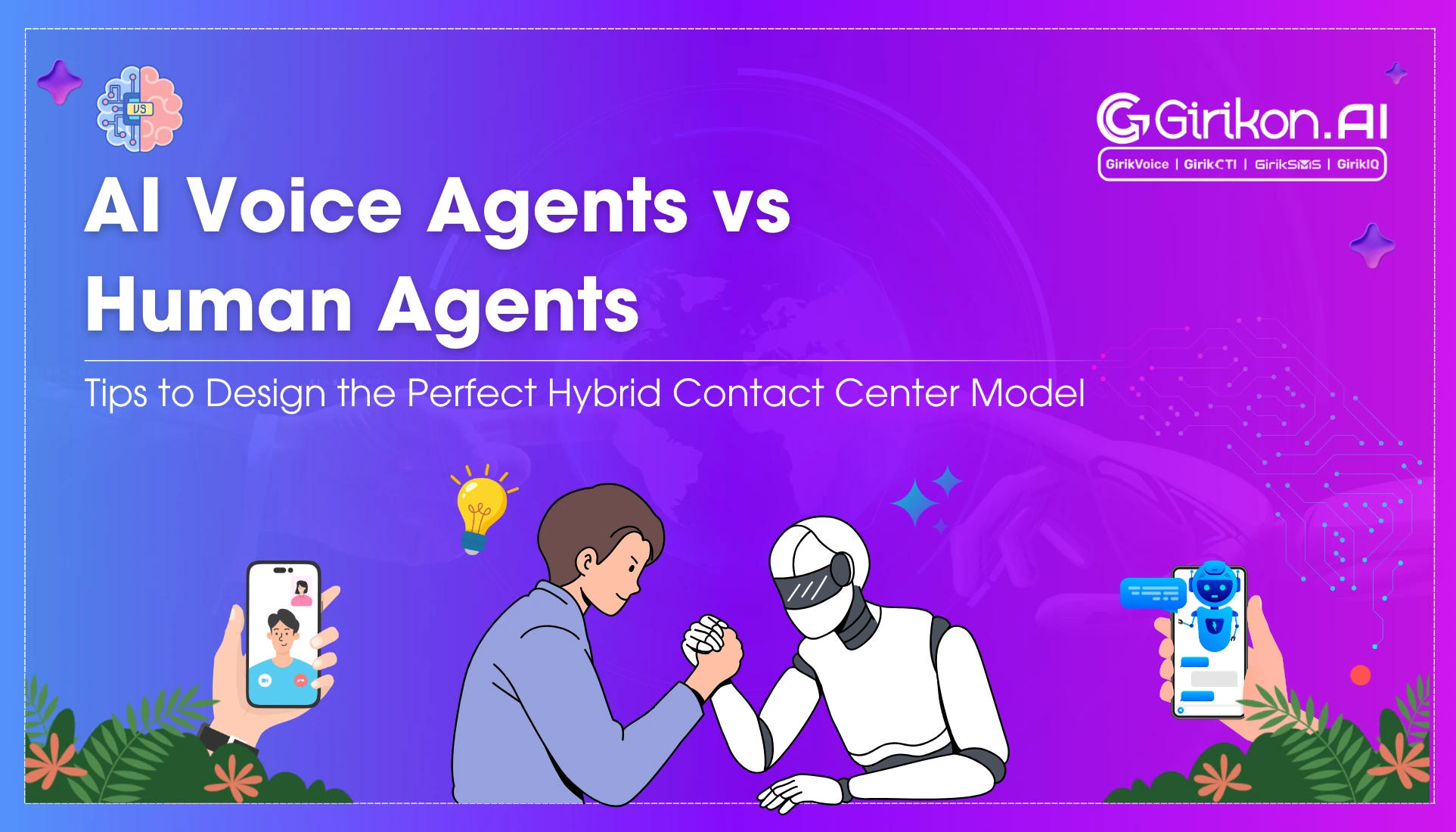
Compare AI voice agents and human agents to understand how a hybrid contact center model enhances efficiency, customer satisfaction, and business performance.
- 1Design a hybrid contact center model by segmenting interactions based on complexity and frequency to determine AI or human agent suitability.
- 2Integrate AI and human agent systems to ensure seamless context transfer, allowing human agents to access complete interaction history and account data.
- 3Establish precise escalation criteria to effectively route complex or sensitive issues to human agents without overwhelming them with routine queries.
- 4Leverage AI for high-frequency, structured inquiries to reduce operational costs and improve response times, while reserving human agents for nuanced problem-solving.
- 5Recognize that AI excels at consistent, round-the-clock handling of routine tasks, whereas human agents are essential for emotional situations and complex problem-solving.
AI Voice Agents vs Human Agents: Tips to Optimize Hybrid Contact Center Model Design
Many contact centers face issues that staffing models did not plan for. Operations end up not matching what is needed now. Call volumes have increased since customers want faster responses and it costs more to have teams working all hours on many query types.
It feels like picking best CTI for Salesforce can boost productivity through routing and integration but does not remove the need for humans. Automation might seem to solve expenses but creates other problems. A wrong AI interaction such as a frustrated customer or billing dispute can damage relationships long after any gains. Maybe that part gets overlooked sometimes.
The hybrid contact center model is built on a more practical premise: different interaction types warrant different handling. AI manages structured, high frequency contact efficiently. Human agents manage tasks that need judgment. Automated systems can handle structured tasks. They work in parallel, each having their own role, without one being subordinate to the other. So, let's explore the steps that can help you build hybrid contact centers and some mistakes to avoid for a better AI call center strategy.
AI Voice Agents vs Human Agents: What's the Difference?
| Factors | Voice Agents | Human Agents |
|---|---|---|
| Availability | Functions continuously without staffing limits or shift-based overhead | Restricted to scheduled hours; extending coverage raises operational cost |
| Consistency | Delivers uniform responses regardless of call load or timing | Performance shifts with workload strain, skill, and situational pressure |
| Complex Problem Solving | Operates effectively within programmed boundaries; limited outside parameters | Handles ambiguity, multi-step issues, and exceptions with reliability |
| Emotional Situations | Limited in recognizing distress or adapting tone | Skilled at de-escalation and managing sensitive interactions |
| Cost at Scale | Per-call expense declines as volume grows | Expenses rise directly with headcount and working hours |
Why Businesses Choose the Hybrid Contact Centre Model
Businesses choose hybrid contact center model because core operational issues aren't solved by either full automation or human agents. AI customer service manages volume without fatigue but has clear limits when interactions require contextual judgement. A fully staffed contact center carries linear cost increases as demand grows, and maintaining quality across all hours requires resources most organizations cannot sustain. The hybrid contact center model addresses both constraints within a single operating structure.
-
Reduced cost per interaction as voice AI automation absorbs routine contact volume, helping reduce call center costs with AI by changing the cost structure without reducing service capacity.
-
Continuous availability of an AI call center strategy removes the dependency on staffed hours for customer access.
-
Shorter resolution time on standard queries and interactions that follow a predictable path are completed faster when automation handles them without transfer.
-
Human capacity directed to complex work as agents are available for interactions where their involvement produces a different outcome, not spent on queries that don't require it.
How to Build Hybrid Contact Centre Model in 5 Steps
-
Define Interaction Categories First Before starting implementation, check your own contact data, rather than how a vendor sets up the system. Analyze incoming interactions, segment them according to the nature of the queries, their level of complexity and frequency, and determine when automation is suitable, and when it's not. High frequency, structured contacts like confirmations, standard account queries, and status updates are suited to voice AI automation. Complaints, disputes, and sensitive circumstances are not.
-
Connect AI and Human Systems for Context When transferring between an AI voice agent to a human agent, context must be there and there's no need to reexplain the situation from the beginning. Salesforce AI contact center infrastructure allows interaction history, account data, and case context to remain available across both channels. The human agent receives the conversation as it stands not a summary or a transfer note, but a complete insight, ensuring handoff is functional rather than disruptive.
-
Set Escalation Criteria Against Specific Conditions Escalation logic in salesforce cti integration requires precision. Criteria that are too narrow leave customers unable to exit automated interactions when their situation warrants human involvement. When they're too broadly defined, escalation rules can push volumes to agents that automation was capable of resolving. Effective escalation triggers are built from specific, observable conditions, particular query categories, a defined number of failed resolution attempts, detected sentiment shifts, or an explicit customer request. These triggers should be tested against real interaction data before the model goes live to ensure the salesforce cti integration performs as expected, rather than being adjusted only after customer complaints surface.
-
Train Agents for Hybrid Workflows Not all cases that go through hybrid contact center and reach human agents have only a fraction of the overall interaction volume as routine queries are handled elsewhere. So, agents receive a disproportionate share of complex, escalated, and sensitive situations. Training must reflect that reality. Human vs AI agents in a hybrid structure aren't doing the same work; agents need stronger capability in managing difficult conversations, working with AI-generated context, and resolving multilayered issues. Standard onboarding when built around product knowledge and call scripts isn't capable of preparing your team for what the model sends their way.
-
Track Performance Across the Full Interaction Measuring AI containment rates and human agent satisfaction scores as separate indicators produces an incomplete knowledge about the performance. A customer who is being managed in automation but gets no resolution isn't captured as a failure in either metric. While evaluating Salesforce Call Center Pricing is important when planning an AI-powered support strategy, organizations should also consider the value delivered through comprehensive analytics. Salesforce AI contact center analytics provide a unified view of resolution rates, escalation frequency, handle time, and customer satisfaction measured across the complete interaction from first contact to close. That unified perspective reveals whether the model is producing the intended outcomes or simply performing well on individual metrics while missing the broader business objective.
Some Dos and Don'ts for a Solid AI Call Center Strategy
- Start with a limited, well-defined interaction category before expanding across the contact center.
- Disclose to customers if an AI system is part of the interaction.
- Apply sector-specific compliance requirements when handling sensitive information.
- Don't leave emotionally charged interactions or sensitive issue-resolution to AI Customer Service agents.
- Don't measure escalation volume as a failure indicator; it exists to protect service quality, not to be minimized at the expense of it.
Conclusion
The hybrid contact center model isn't a transitional arrangement while organizations work toward full automation. It's needed because it recognizes AI call center strategy and human judgement as complementary rather than competing. While both human agents and AI agents have their own benefits, a hybrid approach wins. It's because the contact center assigns each to the work it handles well and builds the infrastructure to move between them without losing continuity or context.
What determines whether a hybrid contact center model performs or not is how interaction types are defined; escalation is configured, systems connect, and how outcomes are measured across the full customer journey. Organizations that invest in this design work will operate Salesforce AI contact center that serve customers more effectively and cost less to run.