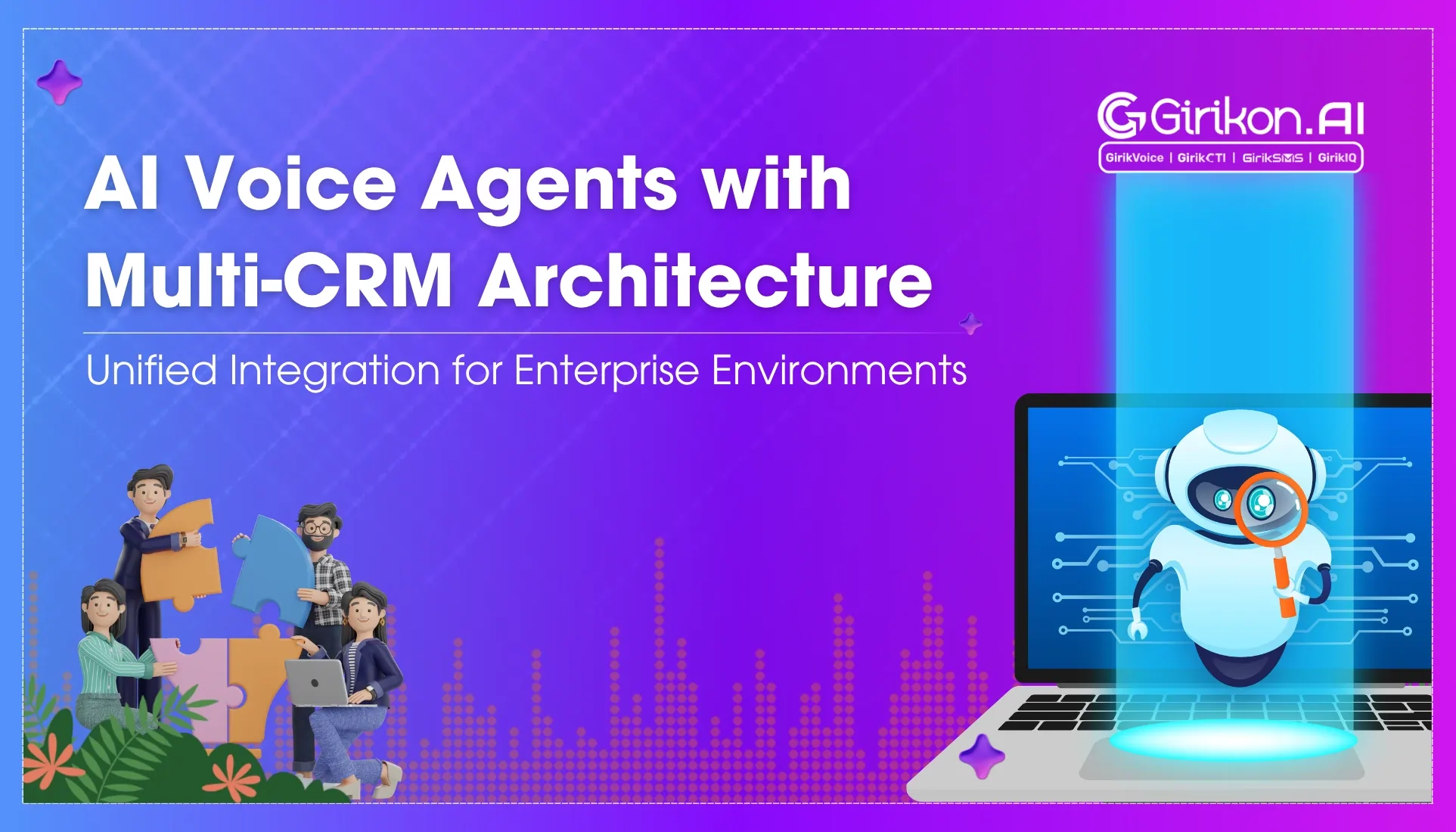
Learn how AI voice agents with multi-CRM architecture help enterprises to eliminate data silos, synchronize customer information in real time and deliver personalized experiences across Salesforce, HubSpot, Zoho and other CRM platforms through unified integration.
- 1Integrate AI voice agents with multi-CRM architecture to unify fragmented data and customer experiences across diverse business units.
- 2Leverage AI voice agents to overcome operational inefficiencies caused by data dispersion across multiple CRM platforms like Salesforce, HubSpot, and Zoho.
- 3Deploy AI voice agents powered by NLP and machine learning to handle complex customer interactions and provide real-time, personalized support.
- 4Implement a data orchestration layer with a Voice AI Engine and Integration Middleware to enable seamless communication and data exchange between AI agents and multiple CRMs.
- 5Utilize CRM connectors to ensure secure and reliable data transfer, providing AI voice agents with a 360-degree customer view for enhanced engagement.
To sustain today’s competitive digital-first landscape, organizations must consider digitally transforming themselves. Since organizations function across multiple departments and business units, each gaining support across different CRM platforms. While Salesforce might be ideal for Sales teams, support teams might find HubSpot as the ideal platform and so on. Managing interactions across these fragmented systems creates major challenges such as fragmented data, conflicting customer experiences, and inefficient workflows, which impacts productivity, as well as client satisfaction.
This is where AI voice agents with multi-CRM architecture are changing how enterprise operations are being conducted. By connecting with several CRM platforms, smart voice agents can create a unified communication framework - enabling hassle-free discussions while ensuring structured data across the organization.
Let’s explore the benefits of AI voice agents for multi-CRM integration, how they function, implementation strategies, and what makes them crucial for modern enterprise settings.
All You Require Knowing About Multi-CRM Business Environments
Forward-looking enterprises function with multiple CRM systems rather than a unified platform. As organizations grow, expand into new markets, or adopt tailored solutions for different divisions, client data gets disbursed across different CRM platforms such as Microsoft Dynamics, Salesforce, Zoho and more.
While every system caters to the needs of its team, the data fragmentation caused can lead to major operational challenges. When a client reaches out, valuable data may be scattered across different platforms - forcing agents to toggle between systems to gain an overall view of the customer relationship. This not just slows response times and minimizes productivity but also augments the risk of inconsistent interactions.
The challenge becomes even more dire when AI-powered customer engagement solutions are implemented. Without hassle-free integration across different environments, voice AI systems can get access to a portion of the accessible client data. This limits their ability to deliver precise, tailored and contextual interactions.
Data Fragmentation
Customer information spread across different CRM systems creates disconnected records, reducing visibility and making personalized service difficult.
Operational Inefficiency
Agents often switch between multiple platforms to access information, increasing response times and creating inconsistent customer experiences.
The Rise of AI Voice Agents in Enterprise Operations
AI voice agents have evolved way beyond traditional phone systems to become intelligent interactive platforms capable of tackling complex client interactions. Powered by recent technologies such as Natural Language Processing (NLP), machine learning, predictive analytics, speech recognition and more, advanced voice AI solutions can handle client queries, make bookings, filter leads, apprise records, and support a wide range of service operations.
While these qualifications are remarkable, the true business value of AI voice agents is realized when they are effortlessly connected to enterprise applications and client data sources. This makes CRM integration a crucial aspect of successful voice AI deployment - enabling agents to avail real-time client data, deliver tailored interactions, and drive efficient business processes.
How AI Voice Agents for Multi-CRM Integration Work?
Successful voice AI integration for CRM environments relies on a data orchestration layer that integrates AI voice agents with several CRM platforms and enterprise applications.
The architecture includes various key components including:
-
01
Voice AI Engine
The Voice AI engine enables AI voice agents to discourse easily with customers. Combining advanced capabilities such as intent detection, speech recognition, context management, and response generation to comprehend client requests and deliver humanized responses. By maintaining context and precisely interpreting user intent, the Voice AI Engine confirms seamless interactions while supporting tailored and efficient client engagement.
-
02
Integration Middleware
Integration middleware serves as the central layer of interaction between an AI voice platform and multiple CRM systems. It handles system interoperability, validation, data transformation, workflow planning, and issue resolution - ensuring smooth and secure exchange of data. By organizing discussions across platforms, the middleware paves the way for seamless communication, supports information accessibility, and ensures AI voice agents operate within complex environments.
-
03
CRM Connectors
To ensure secure and reliable exchange of data between AI voice agents and multiple CRM platforms, dedicated CRM connectors are required. These connectors enable voice agents to avail client records, create and filter leads, list client interactions, and handle support cases in real time.
-
04
Unified Data Layer
It serves as a central repository that combines client information from multiple CRM systems into a single source of truth. Powered by Customer Data Platform (CDP), this layer offers AI voice agents with a detailed view of customer interactions, history and preferences. By accessing a client profile rather than seeking answers from multiple systems independently, voice agents can deliver faster, and highly individualized customer experiences.
What are the Significant Benefits of Voice AI Agent Enterprise CRM Sync?
One of the best capabilities of modern AI voice platforms is voice AI agent enterprise CRM sync. Real-time synchronization ensures that information gathered during discussions becomes available across different systems:
Voice AI Agent Enterprise CRM Sync Benefits
Operational Advantages
- Real-Time Record Updates
- Automated Activity Logging
Governance Advantages
- Better Compliance
- Consistent Customer Records
-
01
Real-Time Record Updates
When customers share new details, AI voice agents can synchronize updates across multiple CRM systems that too in real time. This ensures consistent and accurate records across the organization.
-
02
Automated Activity Logging
Every discussion can be logged within appropriate CRM systems by default. This creates detailed interaction history without requiring manual data entry.
-
03
Better Compliance
Maintaining consistent client records across various systems fulfills regulatory guidelines and data governance initiatives.
Why Multi-CRM Voice AI Matters for Modern Enterprises
As customer expectations become growing complex, delivering exceptional experiences would require more than disjointed systems and fragmented data. AI voice agents for multi-CRM integration provide an integrated approach that integrates conversational AI with different CRM platforms.
Through effectual voice AI integration for CRM environments, organizations can do away with data silos, automate processes, optimize client interactions, and ensure real-time client information through every business interaction.
Final Words:
As customer expectations become growing complex, delivering exceptional experiences would require more than disjointed systems and fragmented data. AI voice agents for multi-CRM integration provide an integrated approach that integrates conversational AI with different CRM platforms. Through effectual voice AI integration for CRM environments, organizations can do away with data silos, automate processes, optimize client interactions, and ensure real-time client information through every business interaction.