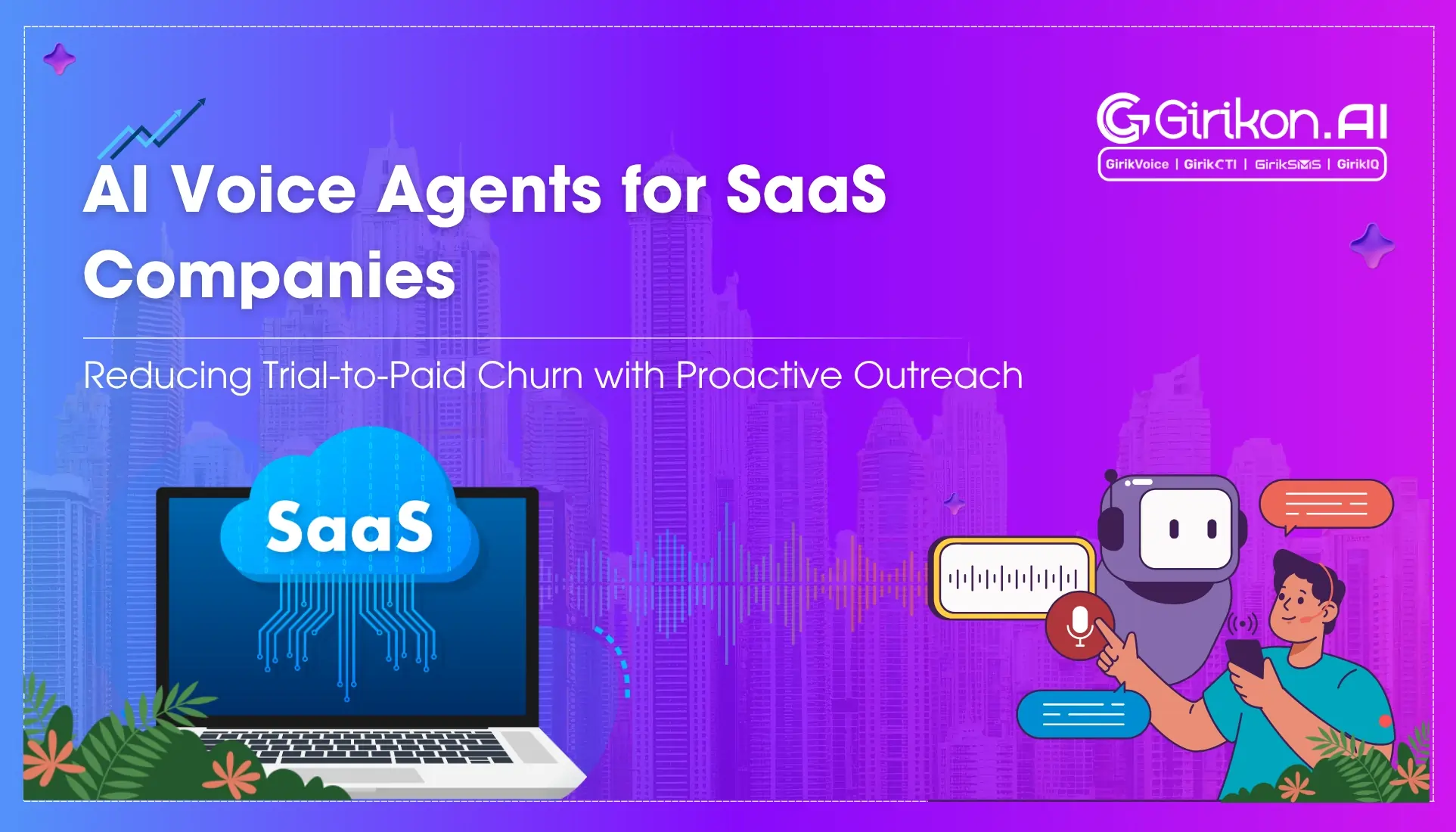
Learn how AI voice agents help SaaS companies reduce trial-to-paid churn through proactive outreach, personalized engagement, and faster user activation.
- 1Deploy AI voice agents to proactively engage trial users and resolve setup or integration blockers in real-time, reducing friction and maintaining momentum.
- 2Personalize outreach by referencing actual user behavior and usage data to build trust and accelerate activation, effectively scaling persuasion.
- 3Implement a four-step playbook: Detect usage triggers, Reach out at the optimal time, Resolve user blockers, and Escalate high-intent leads to human sales reps.
- 4Design natural, empathetic conversations for voice agents, ensuring they possess product context and clearly outline opt-out and compliance procedures.
- 5Measure the impact of AI voice outreach by tracking key metrics like trial-to-paid conversion rates and time to conversion, not just vanity metrics.
Trials fizzle out. People forget where they were. Most SaaS buyers just disappear - no drama, no email, nothing. It happens quietly. But here’s the thing - we don’t need to accept that. Quietly sliding users into churn isn’t the only play. We can gently push trial users toward paying without the spam noise. A well-timed, human-feeling call does more than a dozen generic emails. And that’s the key differentiator of AI voice agents – they bring in a conversation layer that blends timing, context, and empathy. It’s about reaching people where they actually are - in spoken language, not just in an inbox - and doing it in a way that helps, not interrupts.
How AI Voice Agents for SaaS Reduce Trial-to-Paid Churn (The Real Mechanics)
Three things happen when voice works well:
Friction Disappears in Real Time
When a user stalls on setup or an integration, a quick call can say, “We saw your integration didn’t finish - want us to walk through step two now?” That resolves the blocker faster than three emails. Momentum stays.
Persuasion Feels Personal, Scaled
An agent can reference actual usage: “You created three automations but didn’t enable them - want help enabling?” This builds trust and reduces activation time.
Escalation Happens Faster
When a conversation shows high intent, the agent transfers the call or schedules a human on the spot. No waiting. For low-intent cases, the agent handles it end-to-end, saving SDR time.
Log Responses, Route Leads, and Refine the Product
We listen for what users say. When objections surface, we catch them. Hot leads go to human sellers quickly. The ones that don’t light up right away stay in the loop with targeted follow-ups. And we also take what we learn from the calls - the objections, the questions, the quick wins - and use that to tweak onboarding flows and product messaging. Small shifts, real impact.
Types of AI Outreach That Actually Move the Needle
You don’t use one script for everything. Match the type to the goal in your funnel.
- Quick check-insShort calls to confirm setup.
- Feature nudgesShort guided walkthroughs triggered after someone tries a key feature but doesn’t enable it.
- Risk recovery callsRe-engagement when usage dips mid-trial.
- Renewal nudgesFor trials that got extended or are creeping toward payment day - timely reminders that include upgrade options.
Operational Model - Rollout Without Chaos
Segment and Prioritize
Pick the right groups to reach: trial users who completed key activation steps, those on paid-feature trials, and accounts with high ARR potential.
Exclude low-value or non-English trials early.
Define Triggers
Low usage after X days, failed integrations, feature threshold reached but not enabled, calendar reminders.
Design Scripts and Flows
- Keep basic check-ins under 2 minutes.
- Use branching logic: if a user says “setup issue,” route to guided steps; if “need pricing,” escalate to sales.
- Open with context: reference the product action that triggered the call.
Measure Outcomes
Measure what matters: track KPIs.
Mini-Framework: 4-Step Voice Agent Playbook
- Detect - extract from product hooks and events.
- Reach - call in the right window (24 - 72 hours after trigger).
- Resolve - clear the main blocker in the call.
- Escalate - hand off complex or high-value leads to humans.
Designing Conversations That Don’t Feel Robotic
Voice agents need to sound human enough to be helpful - not eerie.
- Use brief scripts with small digressions. Avoid robot polish.
- Let the voice breathe: use natural pauses with short sentences.
- Bail out cleanly: if the agent can’t solve it, offer a human callback.
- Honor opt-outs and follow local calling rules. Consent matters, always.
Make sure the agent has product context: trial tier, recent events, known issues. Without that, voice becomes empty.
Ethics, Compliance, and Privacy - Non-Negotiable
This isn’t optional. Voice touches sensitive zones.
| Requirement | Best Practice |
|---|---|
| Consent | Your trial flow must capture permission for voice contact. Opt-outs must be easy. |
| Recording | Tell users when calls are recorded. Provide transcripts on request. |
| Data Exposure | Expose only what’s necessary in calls. |
| Local Laws | Follow telemarketing and privacy rules in each market. |
Metrics That Matter (Not Vanity)
Track what shows real impact:
- Trial-to-paid conversion rate (cohorted and A/B tested).
- Lift from voice outreach vs. baseline.
- Time to conversion (days saved).
- Net revenue retention and churn delta for affected cohorts.
- Cost per conversion (agent runtime, credits, escalation costs).
- Sentiment and NPS of called users.
We care about SaaS customer retention automation because it ties directly to long-term value. That’s why we measure deltas, not just clicks.
Tactics That Boost Effectiveness
- Time callsLate afternoon or early morning often get better pickups. Test windows.
- In-call CTAsQuick link to enable a feature, one-tap upgrade, schedule a human.
- In-app nudgesAlign the call with a small in-app banner so users know outreach is coming.
- LocalizationNative-sounding voice converts better.
- Voicemail snippetsShort, compelling voice notes with a callback option.
Common Issues and Addressing Them
- “We’ll annoy users.” Keep calls brief, contextual, and easy to opt out of.
- Scaling. Use AI voice agents for the broad middle cases and escalate only high-intent cases.
- “Compliance overhead is high.” Bake consent and recording policies into trials from day one.
Feature-Benefit Snapshot
| Features | Benefit |
|---|---|
| Context-aware triggers. | Calls happen when users actually need help. |
| Short scripted dialogs. | Quick resolution, better pick-up rates. |
| Escalation routing. | Humans handle complex sales, AI handles volume. |
| Transcripts and analytics. | Drive continuous improvements to product flows. |
Real-World Example (Illustrative)
A mid-market project management SaaS noticed many trials stalled after users tried importing CSVs. They set a trigger: if import fails twice, an AI voice agent calls within 12 hours to offer guided steps. Import completion rose. Trial activation increased. Trial-to-paid conversions for that cohort grew by a measurable margin. The agent handled most of these calls without human help; the rest escalated to sales.
Implementation Checklist
- Map your trial funnel and identify three top friction points.
- Build triggers and test one cohort.
- Record short scripts plus escalation rules.
- Make sure consent and regulatory checks are completed before launch.
Pitfalls and How to Avoid Them
- Overcalling: throttle outreach frequency.
- Generic scripts: use context, or users tune out.
- Ignoring transcripts: analyze them weekly for insights.
- Launching too fast: start small and evolve.
We also track trial conversion automation lift because it shows how efficiently we move users from curiosity to commitment. And we use SaaS customer onboarding AI so the first experience feels guided, not confusing. When we pair onboarding with voice, confusion drops.
Final Thought - The Human Element Scales
At the end of the day, trial-to-paid churn often comes down to one thing: a human moment at the right time. AI customer success calls give us that moment at scale. They free sales to focus on complex value conversations and give users an immediate, empathetic touchpoint when they need it most. It’s not magic. It’s better timing, better context, and more useful conversations.
Highlight: Quick Tip
Make the first outreach conversational and short - a 60 - 90 second check-in. People appreciate brevity. Keep the rest as options.
Now test one friction point this quarter. Start small, measure lift, and scale what works. You’ll be surprised how much a brief, human-feeling call can change the math on trial conversion. That’s where SaaS churn reduction becomes real.