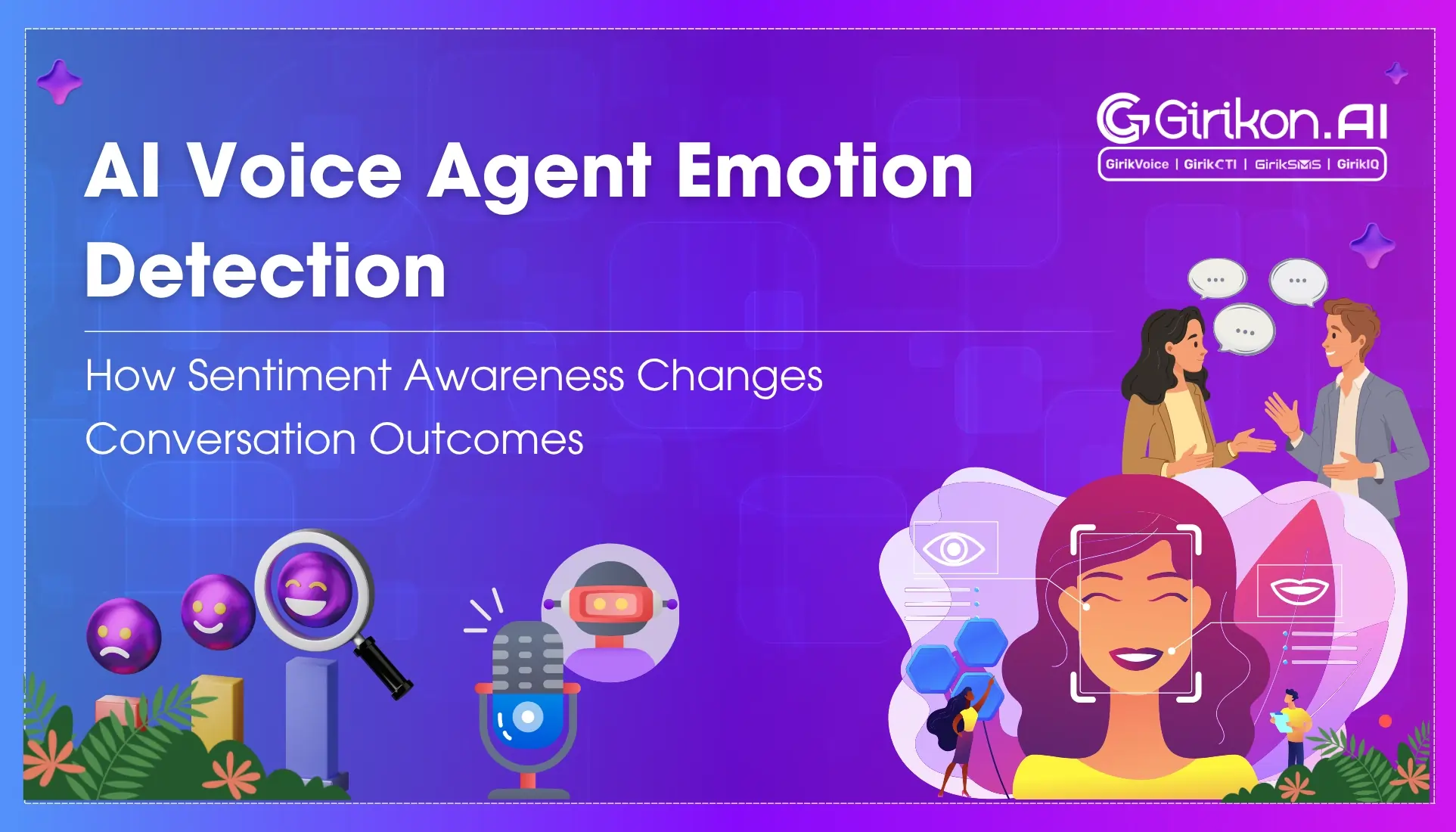
AI voice agent emotion detection enables real-time sentiment awareness during customer conversations. By analyzing tone, speech patterns and intent, businesses can identify frustration, reduce churn risk, improve escalation decisions and deliver more personalized customer experiences.
- 1Prioritize real-time sentiment detection in voice AI to capture emotional shifts during live conversations, enabling timely interventions.
- 2Integrate acoustic signals (pitch, pace, pause) with semantic content for accurate emotion detection, as text alone can be misleading.
- 3Focus on detecting escalation patterns, not just individual utterances, as recurring complaints can signal underlying frustration even in calm tones.
- 4Ensure AI systems are domain-specifically trained or fine-tuned on real call data to achieve production accuracy, as general emotional data is insufficient.
- 5Evaluate voice sentiment capabilities by testing for low latency, granular emotion distinction, integrated acoustic analysis, domain fit, and configurable escalation behavior.
AI Voice Agent Emotion Detection: How Sentiment Awareness Changes Conversation Outcomes
Somewhere around the ninety-second mark of a bad customer call, something shifts. Not in the words - the words are almost always polite enough, at least initially - but in the texture of how they are delivered. A slight uptick in pace. A pause that lands a beat too long. A sentence that ends flatter than it started. Good human agents can catch this. Automated systems? For most of the last decade, they were essentially blind to it - processing words, missing everything underneath. Emotion detection voice AI is what is finally changing that, though "finally" might be generous given how long this problem has been obvious. The effects on how calls actually resolve are more significant than most operations teams have budgeted for.
What Sentiment Awareness Actually Means in Practice
People use "sentiment analysis" to mean about six different things depending on who is in the room. Running a post-call transcript through a keyword tagger and counting how many negative words appeared - that is not really what we are talking about. That is a reporting exercise. The thing that actually moves outcomes is capturing sentiment as it develops during a live interaction, and doing something useful with that in real time.
Sentiment aware AI agents have been closing in on this for a couple of years now, and the better ones do something that even experienced human agents sometimes miss under volume pressure. They separate the customer who is venting - loud, pointed, but fundamentally still engaged - from the customer who has gone quiet in that particular way that means they have already mentally cancelled. Same frustration, different trajectory, completely different intervention required. Getting that distinction right is the whole game, honestly.
The inputs these systems draw on are a mix of acoustic signal - pitch, pace, pause patterns, volume shifts - and semantic content from the transcript. Text alone lies. Tone alone is ambiguous. It is the combination that gets you somewhere close to reliable.
How the Technology Actually Works
Most mature implementations run two processing streams simultaneously. One is handling the NLP side - transcribed speech, intent classification, polarity scoring. The other is working through prosodic analysis, pulling the acoustic features in near real-time. Both streams feed a model that updates its emotional state estimate every few seconds as the conversation moves.
Here is the timing problem that conversational sentiment analysis in voice contexts has never fully shaken: labelling an emotion takes long enough that the conversation has usually moved on before anything can be done about it. The label arrives, the moment has passed. So what the better systems have started doing is less about scoring the current state and more about watching the pattern - three restatements of the same complaint, even in a calm voice, is an escalation signal. The individual utterance is almost beside the point.
One thing that does not get said enough: systems trained on general emotional data tend to underperform in specific business contexts. The emotional grammar of a billing dispute is genuinely different from the emotional grammar of a delayed delivery claim. Domain-specific training - or at minimum, fine-tuning on real call data - is not optional if you want production accuracy to resemble demo accuracy.
A Framework for Evaluating Voice Sentiment Capabilities
Before committing to any platform, put it through these five tests:
- Latency Emotional state should update in under five seconds during a live call. Longer than that and the system is annotating history, not informing decisions.
- Granularity Binary positive/negative scoring is nearly useless operationally. Look for systems that can distinguish frustration from confusion from urgency from genuine distress.
- Acoustic Integration Ask directly whether prosodic analysis is built into the model or bolted on. Some vendors use "emotion detection" as a label for what is essentially text sentiment with a nicer interface.
- Domain Fit Dig into whether the training data resembles your actual call environment. Accent distribution, industry vocabulary, customer demographics - these are not footnotes. They are the difference between a model that performs in testing and one that holds up in production.
- Escalation Behaviour Detection without a sensible next step is just observation. A system that flags distress and then does nothing configurable with that information is not really a tool, it is a dashboard. The escalation logic needs to be something your team can actually tune.
This is where a lot of CX technology buying goes wrong. Vendors demo in clean conditions with articulate speakers and a stable connection. Real production calls are messier in ways that compound - background noise layered over a regional accent layered over a customer who keeps interrupting themselves. Audio quality alone can tank model performance in ways that almost never show up in a controlled evaluation. Whether vendors are willing to share accuracy data from actual live deployments, rather than lab conditions, is usually a revealing question to ask.
AI Voice Agent Sentiment Analysis: The Business Case Beyond CX
| Capability | Reactive System (No Sentiment AI) | Sentiment-Aware System |
|---|---|---|
| Escalation Trigger | Customer explicitly requests supervisor. | System detects emotional threshold, suggests escalation proactively. |
| Script Adaptation | Fixed flow regardless of customer state. | Real-time path modification based on detected emotion. |
| Agent Support | Agent receives no emotional context. | Agent receives emotion summary before taking over call. |
| Post-call Analysis | Transcript reviewed manually. | Automatic sentiment tagging across 100% of calls. |
| Churn Risk Flagging | Identified retroactively. | Flagged during call for immediate intervention. |
The financial argument for AI voice agent sentiment analysis is most convincing when it sits in front of a retention model rather than a CX budget conversation. If you can identify which customers are at genuine churn risk during the call - not after they have left, not in a win-back campaign three weeks later, but in the moment - and route even a fraction of those toward a better resolution, the economics work themselves out fairly quickly. The technology is not cheap. The cost of customer acquisition that replaces avoidable churn is usually worse.
Anyway, retention is the obvious line. The less-obvious one is handle time. Agents who receive an emotional state summary before picking up an escalated transfer do not spend the first two minutes of the call figuring out who they are dealing with. That time saving, multiplied across thousands of escalated calls per month, is not trivial.
The Nuances That Vendors Do Not Always Surface
-
Voice AI sentiment tracking at scale runs into some genuinely thorny problems that tend to surface after deployment rather than before. Cultural calibration is one of them. Emotional expression is not universal - the way someone from one city or background signals that they are close to hanging up is not the same way someone else does it, and a model that was mostly trained on one kind of caller will get this wrong, quietly and repeatedly, until someone digs into why the escalation rates look off in certain regions.
-
Then there is the feedback loop problem. Agents who know the system is scoring emotional state and making routing decisions accordingly will, over time, adjust their behaviour to influence those scores. This is not unusual or even cynical - it is just what happens when people operate inside a scoring system.
-
There is also the false positive / false negative problem, which is more lopsided than it looks. A customer who naturally speaks loudly and with animation will get flagged repeatedly for frustration they are not actually feeling. A customer who processes stress by going quiet and controlled may never trigger an escalation threshold until they are gone.
What Good Implementation Actually Looks Like
The deployments that hold up - and there are fewer of them than the vendor case studies suggest - tend to have a few things in common that are less about technology choices and more about how the work is organized around the technology:
- Calibration is somebody's actual job, not a setting that gets configured at launch and revisited when something breaks. The language customers use shifts over time. A product issue that spikes call volume changes the emotional baseline of everything coming in.
- System outputs are made visible and legible to agents, with enough explanation that people can understand and dispute what the system is telling them.
- Escalation thresholds are reviewed regularly and are not uniform across call types.
- Performance is benchmarked at the outcome level - resolution rate, customer retention, satisfaction scores - rather than just at detection accuracy.
Leaving the Conversation Open
The capability is real. That much is not really in dispute anymore - the question has moved from whether voice sentiment detection works to whether the organizations deploying it have the operational maturity to use it well. And that is a harder question, because it is not a technology problem. It is a staffing and process problem wearing a technology label.
Whether these systems eventually become autonomous enough to not need that continuous human calibration layer - probably. The models are improving fast. But right now, the gap between what the best implementations can do and what most actual deployments are doing is significant, and it sits mostly on the organizational side rather than the technical one. That is probably not the conclusion anyone's pitch deck is built around, but it is closer to what the data from real deployments tends to show.