Improve patient experiences with AI-powered call routing that intelligently directs callers to the right department, reduces hold times, and streamlines care coordination. Learn how hospitals can enhance operational efficiency, support staff productivity, and ensure patients receive timely assistance
- 1Implement AI-powered call routing to intelligently direct patient inquiries to the most appropriate resources, reducing wait times and improving care coordination.
- 2Utilize AI to balance agent workload by monitoring availability and queue lengths, intelligently allocating calls for efficient handling.
- 3Integrate AI call routing with CRM systems to provide agents with immediate access to patient context before the call begins, personalizing the patient experience.
- 4Reduce patient hold times and misrouted calls by leveraging AI for automated, accurate call routing and preventing congestion.
- 5Enable self-service options for routine inquiries through AI, freeing up live agents to handle more complex patient needs.
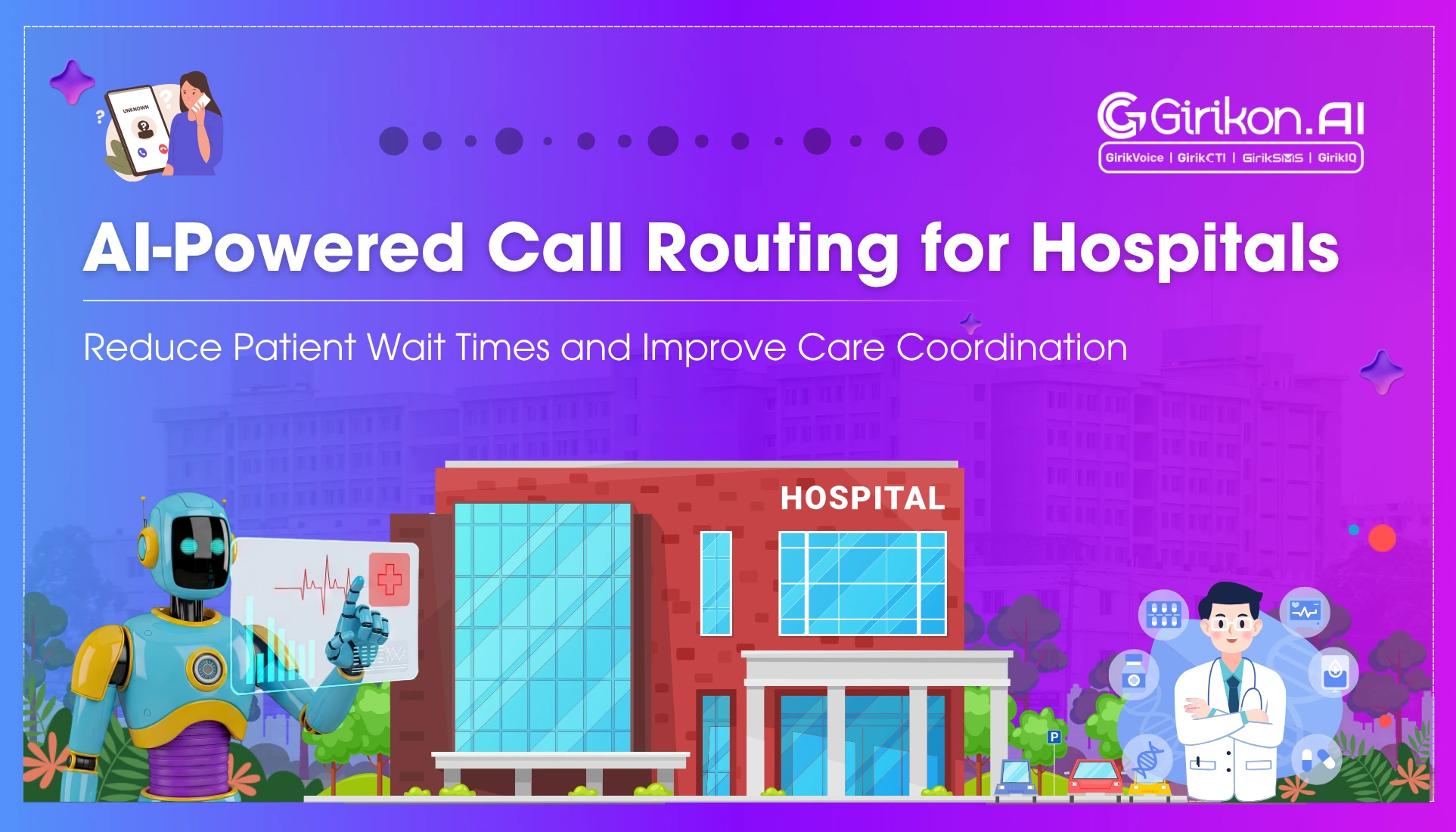
AI-Powered Call Routing for Hospitals: Reduce Patient Wait Times and Improve Care Coordination
"Press 1 for Hindi, press 2 for English, hold till we try to connect with the agent, repeat", how does this sound? Frustrating, right? Imagine a patient on the other end of this call, navigating their way down an endless menu tree and sitting on hold for a long time just to make an appointment. In moments like these, every second feels heavy – pulling you down.
That's where an AI-powered call routing CTI is flipping the script.
By eliminating the usual back and forth, it lets healthcare providers manage many calls with fewer transfers, and quicker resolutions, kind of like keeping the flow calmer. The result? You get shorter wait times, fewer dropped calls, and better care of coordination.
But really, how does AI powered call routing do all of that? Let's go through it.
How AI-Powered Call Routing Reduces Patient Wait Times
Instead of directing callers into pre-defined paths, AI-powered call routing for hospitals understands the nature of their inquiry to direct them to the most appropriate resources. Here is how it does that.
-
Smarter Burden Balancing
There are some periods of the year when hospitals are flooded by calls — whether they're dealing with seasonal illnesses, a wave of appointments, or public health crises. This strains healthcare teams, compelling them to manage chaos instead of care.
AI-powered call routing CTI resolves the issue by first monitoring agent availability, queue lengths, and workload. Then, the system intelligently allocates incoming calls to available agents. On top of it, Salesforce telephony integration provides real-time visibility into agent capacity and call traffic to ensure that the calls are routed and handled efficiently. -
Access to Patient Context Before the Call Begins
The world's largest CRM stores every patient's information while managing healthcare data. And with Salesforce telephony integration, it gives agents immediate access to relevant data as soon as a call arrives.
So, while eliminating the need to start every conversation from scratch, the care team can instantly view patients' appointment history, previous interactions, referral information, ongoing cases, etc. Patients are also not required to repeatedly explain their situation multiple times. Moreover, they are connected with the most appropriate department via AI, and this ultimately leads to a personalized patient experience. -
Less Time on Hold
Misrouted calls, overloaded departments, and redirecting callers to the appropriate team often lead to long wait times. And nothing frustrates patients more than being placed on hold for extended periods, especially during any urgent requests.
That's where contact center AI solution levels things up for hospitals. The system supports automated call routing, prevents calls from ending up in the wrong queue, thus easing congestion across departments. The benefits become even greater when the system has telephony integration Salesforce that provides patients' essential details and eliminates the need to spend the first few minutes collecting basic information. -
Faster First Connection
Needless call transfers when patients try to inquire about billing, reach a specialist, and book an appointment create a poor experience. However, not with a custom IVR builder for Salesforce that analyzes call intent, determines the purpose of the call, and then redirects it to the appropriate agent and department.
So, if a patient calls to reschedule, they get moved toward the scheduling team. Meanwhile, someone asking about an invoice or payment issue gets routed to finance. This kind of thoughtful call flow guides callers along a streamlined path, so they reach the right resource fast. As a result, healthcare providers receive calls that align well with their area of expertise and deliver faster and more efficient service. -
Self Service for Routine Requests
In healthcare, not every call carries emergency; some just require quick information around visiting hours, prescription refill status, appointment confirmations, insurance details etc. Managing these routing inquiries through live agents can consume valuable time, especially when call queues are already congested.
And then there's the self-service flow where care teams allow callers to grab easy details (like visiting hours) without holding up an agent's availability. Faster answers ease strain on those queue lines and leave your care team ready to tackle the truly heavy lifts. All told, it leads to a smoother healthcare experience. -
Priority Routing for Urgent Cases
While some callers seek prescription updates, others request immediate medical guidance and report critical patient situations. In cases like this, every second matters and it cannot be slowed down by multiple call transfers or lengthy hold times. Based on what the caller says, predefined rules, and keywords, the contact center AI solution can spot, then prioritize, what needs immediate attention.
Instead of placing those calls on a standard queue, it automatically moves them from the front door to patient care. The specialized care team, with the context received on Salesforce, respond quickly and take the appropriate course of action. And because they don't divert valuable attention into regathering basic background information, hospitals are able to handle patient concerns more effectively, especially during urgent or time sensitive moments. -
Streamlined Cooperation Across Medical Divisions
It is essential for all members of care teams, like scheduling, admissions, pharmacy, and clinical work in coordination to provide patients with the best assistance. So, if any department or group within the organization communicates poorly, this may result in delayed or inconsistent services.
Luckily, one can eliminate this challenge with AI-powered call routing CTI that allows different healthcare staff to work from the same source of information. With access to patient insights, service requests, case details, and relevant context, they get insights to help information flow smoothly across departments, reducing duplicative work, and speeding up care coordination. This ensures healthcare providers deliver timely and coordinated care along with the patient's journey.
Conclusion
Reduced wait times and improved care coordination are not standalone achievements—but the result of multiple optimizations enabled by AI-powered call center systems. Having this solution in place ensures that every call is handled with context, speed, and accuracy.
From real-time access to patient records to self-service options, and faster first connection, each capability aligns together to eliminate delays. More importantly, fewer handoffs, faster connections, and better-informed agents lead to a smoother healthcare journey and more meaningful interaction.
Having said that, if you are looking to invest in one such AI-powered call routing CTI, a free trial of GirikCTI is a great way to experience its capabilities and evaluate its benefits firsthand.