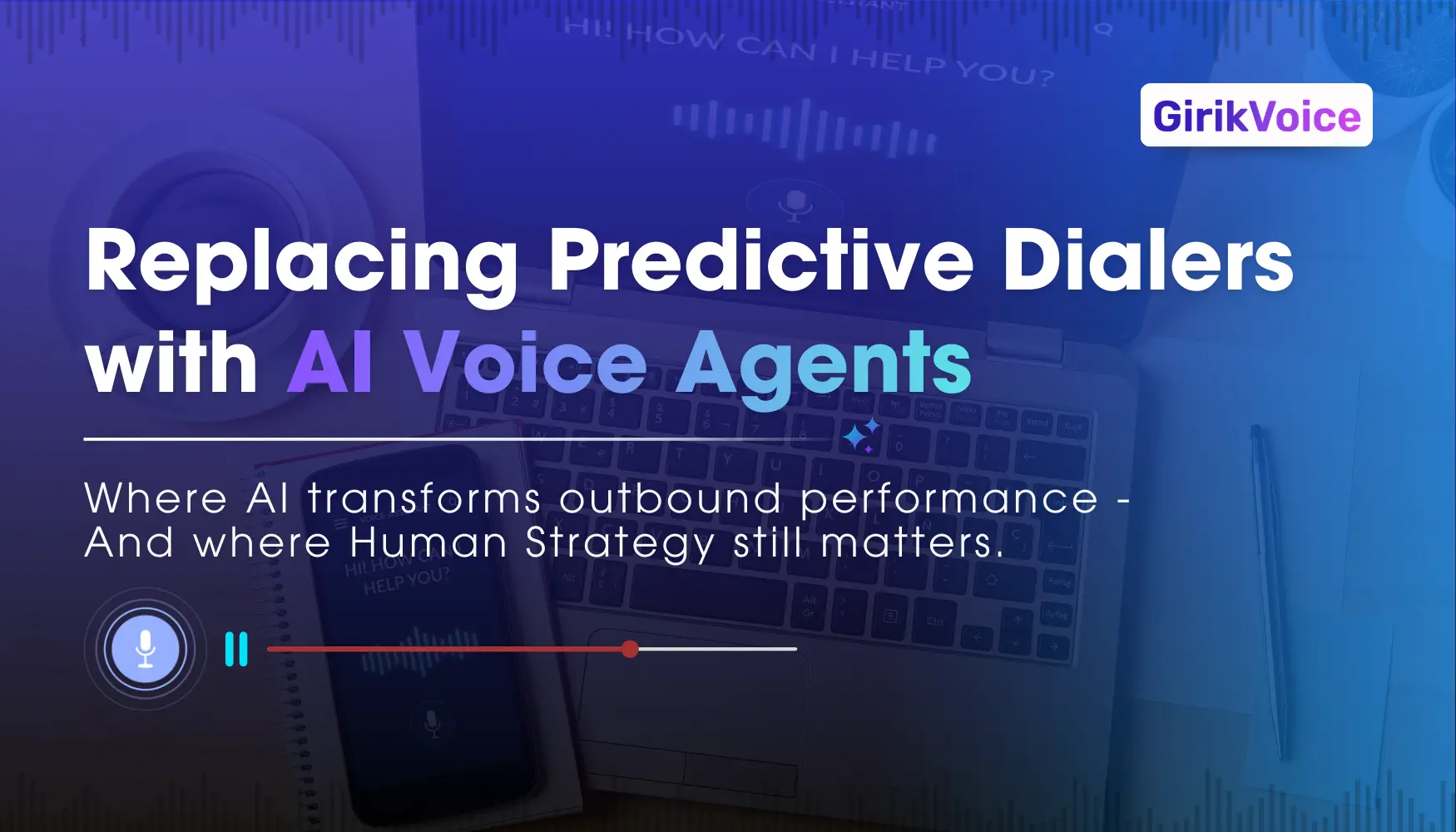
Compare AI voice agents and predictive dialers across scalability, cost, automation, customer engagement, and outbound calling performance.
Choosing the Future of Outbound Calling: AI Voice Agents vs Predictive Dialers
What Are AI Voice Agents?
AI voice agents are conversational systems powered by natural language processing and conversational AI that can engage with customers in real time using natural, human-like speech.
Unlike traditional IVR systems or scripted voice bots, AI voice agents can understand customer intent, respond dynamically, access CRM data, and complete workflows autonomously.
Pros of AI Voice Agents
- Operate continuously without shift limitations.
- Scale large outbound volumes without proportional staffing increases.
- Maintain highly consistent conversations and workflows.
- Reduce long-term operational costs for repetitive interactions.
- Integrate CRM data directly into live conversations.
Cons of AI Voice Agents
- May struggle with emotionally sensitive discussions.
- Require ongoing training and optimization.
- Complex integrations can increase deployment effort.
- Customer trust depends heavily on voice quality and transparency.
What Are Predictive Dialers?
Predictive dialers are automated outbound calling systems designed to maximize agent productivity by dialing multiple numbers simultaneously and routing answered calls to available representatives.
Their primary objective is operational efficiency. Instead of agents manually dialing leads, predictive dialers keep conversations flowing continuously.
Pros of Predictive Dialers
- Increase outbound call efficiency dramatically.
- Reduce manual dialing and agent idle time.
- Maintain direct human engagement during conversations.
- Fit naturally into traditional call center structures.
Predictive Dialer Limitations
- Still heavily dependent on staffing levels.
- Labor costs continue scaling with volume.
- Improper dialing ratios can increase abandonment rates.
- Automation stops once a live call begins.
AI Voice Agents vs Predictive Dialers: 7 Key Differences
| Category | AI Voice Agents | Predictive Dialers |
|---|---|---|
| Primary Role | Conduct conversations autonomously | Connect calls to human agents |
| Scalability | Scales through infrastructure | Scales through hiring |
| Operational Cost | Lower long-term labor dependency | Higher recurring staffing costs |
| Conversation Quality | Structured and automated | Human-driven and flexible |
| Availability | 24/7 operations | Limited by agent schedules |
| Compliance Risks | Disclosure and interpretation risks | Abandonment and dialing ratio risks |
| Best Use Cases | Structured workflows | Negotiation-heavy outreach |
Where AI Voice Agents Work Best
AI voice agents perform exceptionally well when interactions are repetitive, process-driven, and require consistency at scale.
- Appointment confirmations and reminders
- Lead qualification workflows
- Payment reminder campaigns
- Customer satisfaction surveys
- After-hours inbound query handling
Why Enterprises Are Adopting AI Voice Agents
Enterprises are increasingly shifting toward AI voice systems because these platforms combine automation, CRM intelligence, and scalability without requiring large outbound hiring expansions.
Where Predictive Dialers Still Win
Despite rapid advances in AI, predictive dialers remain highly effective for conversations that depend heavily on persuasion, emotional intelligence, or adaptive negotiation.
- Enterprise B2B sales outreach
- Debt collection negotiations
- Fundraising campaigns
- Financial services upselling
- Relationship-focused account management
In these situations, human flexibility and trust-building continue to outperform fully automated systems.
The Real Decision: Efficiency vs Adaptability
The debate between AI voice agents and predictive dialers is not simply about automation. It is about deciding where automation creates value and where human judgment remains essential.
Predictive dialers optimize agent productivity while preserving human interaction. AI voice agents reduce operational dependency on humans by automating large portions of the conversation itself.
The right solution depends on:
- The complexity of customer conversations
- The importance of empathy and negotiation
- The need for scalability and availability
- The operational cost structure of the business
- The level of workflow automation required
Final Thoughts
Predictive dialers helped outbound teams become faster. AI voice agents are helping outbound operations become smarter.
As AI systems continue improving in conversational quality, CRM intelligence, and automation capabilities, businesses are increasingly moving toward hybrid calling environments where AI handles repetitive workflows while human teams focus on high-value interactions.
The future of outbound communication will likely combine the efficiency of automation with the adaptability of human engagement — allowing enterprises to scale operations without sacrificing customer experience.
Scale Smarter Outbound Calling with AI Voice Automation
GirikVoice helps enterprises automate outbound calling workflows with AI-powered conversations, Salesforce integration, intelligent routing, and scalable customer engagement capabilities.
Talk to Our Team