Many Salesforce teams lose qualified inbound leads simply because nobody is available when prospects reach out after hours. This blog explores how AI voice agents instantly answer calls, qualify leads, update Salesforce records and book meetings — helping sales teams reduce revenue leakage and engage buyers while intent is still high.
- 1Capture inbound leads immediately after they express interest, as buyer intent fades rapidly.
- 2Implement AI voice agents to engage with inbound leads outside of business hours, preventing revenue leakage.
- 3Understand that the critical point for lead engagement is when buyer intent is at its peak, not when sales teams are available.
- 4Recognize that delays in lead response can lead to lost opportunities and a negative impact on sales pipelines.
- 5Leverage AI voice agents to ensure that inbound leads are contacted and qualified while they are actively seeking solutions.
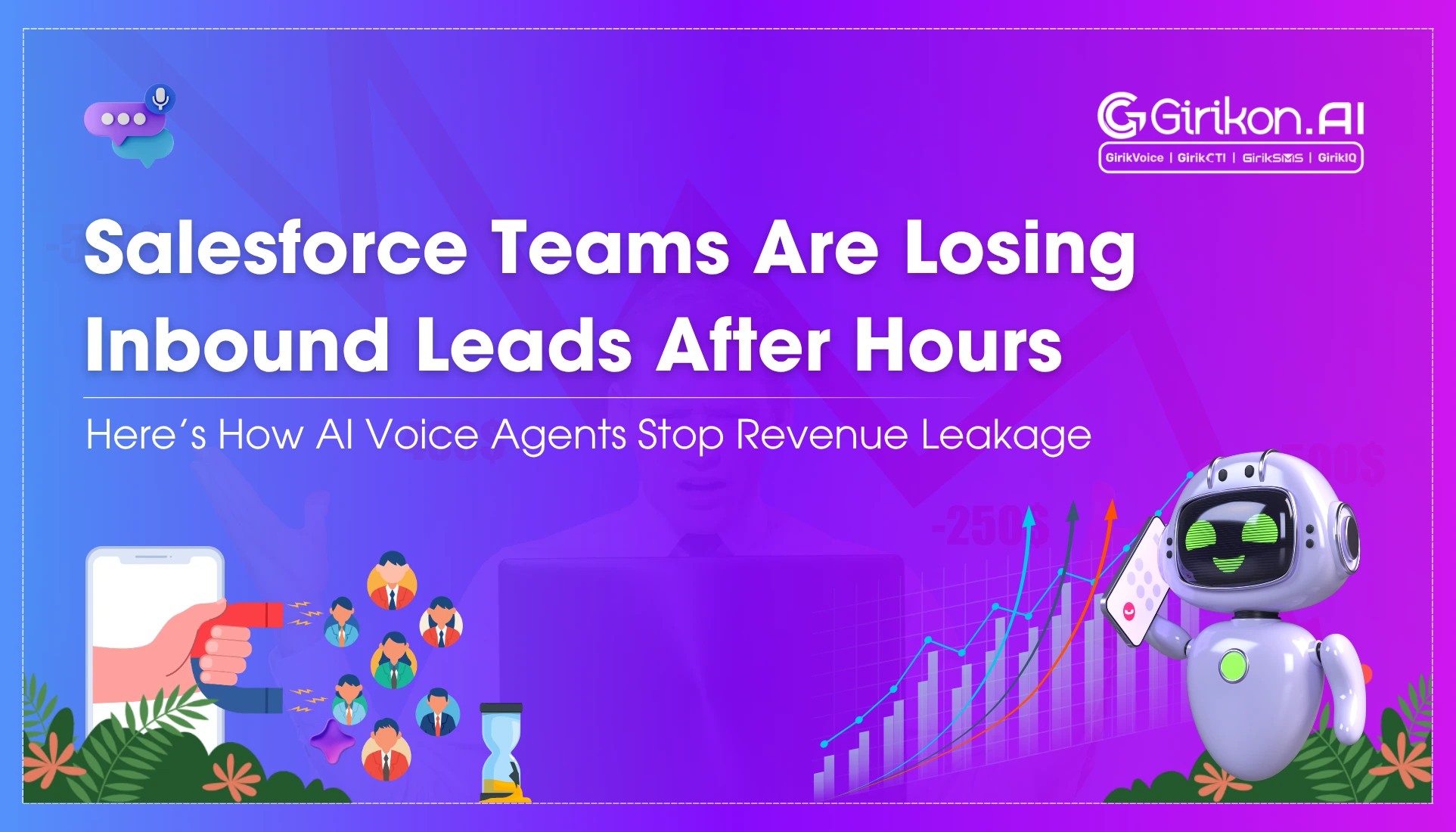
Salesforce Teams Are Losing Inbound Leads After Hours: Here’s How AI Voice Agents Stop Revenue Leakage
Most sales teams assume the hard part is generating inbound demand in the first place. Running campaigns. Ranking in search. Or at least, getting someone interested enough to finally fill out a form or call the sales line.
But in reality, the actual leak in the funnel often happens afterward.
A prospect reaches out at midnight. Other calls during the weekend. Someone responds to an ad while your SDR team is offline. The lead lands inside Salesforce, maybe even gets assigned correctly, but the conversation itself never really starts. By the time a rep follows up the next morning, the prospect may not even remember why they reached out.
And honestly, this is where a lot of missed inbound calls Salesforce teams deal with, quietly turning into a lost pipeline.
That is the reason, AI voice agents are the biggest game changers, especially for the sales teams. Not because they sound futuristic, but because they solve a very operational problem: making sure inbound leads actually get engaged while intent still exists.
And that changes the economics of inbound pretty quickly.
Why Speed-to-Lead Matters More Than Most Salesforce Teams Realize
The thing about inbound leads is that they don't stay "inbound leads" for very long.
A prospect fills out a demo form. Call the sales number. Requests pricing. At that moment, they were actively looking for something. Comparing options. Reading reviews. Talking internally. Trying to solve a problem that's important enough to spend time on.
That's what makes timing matter.
Buying Intent
Buyers don't wait for a sales call to start making decisions. The research has already happened.
The internal arguments have already been had. Someone on their team has already said "let's not go with them." By the time they reach out, they know what they want — they're just deciding who to trust with it.
That's why response time matters. The interest that prompted them to reach out is strongest in that moment, and waiting until the next day can make it harder to pick the conversation back up.
Response Window
If any lead that might have come at 10 PM, might still be interested at 9 AM the next morning. Then again, they might not.
Maybe they found another solution. Maybe a competitor responded first. Or maybe the issue that felt urgent last night is sitting behind six other priorities the next day.
It's difficult to know.
And that's where things start getting expensive.
Missed Opportunities
This is why missed inbound calls for Salesforce teams to deal with after-hours often create a bigger problem than they appear to.
The missed call is only visible.
What sits underneath is a conversation that never happened. The qualification that never took place. The meeting that never got booked. The opportunity that quietly drifted somewhere else before a rep even had a chance to engage.
From inside the CRM, it can look like a lead waiting for follow-up. For the buyer, it's simple — they were ready, and no one was there.
That's a very different experience.
Competitive Reality
And honestly, competitors don't have to be dramatically better at winning those situations.
They just have to be available.
That's partly why more sales teams are paying attention to things like AI inbound call automation and after-hours engagement workflows to shorten the gap between interest and conversation.
Because when inbound demand is already there, speed becomes part of the sales strategy.
Not just the sales process.
What AI Voice Agents Actually Do After Hours
What a modern voice AI is doing is a little different.
Instead of acting like a gatekeeper, it acts more like a first responder for inbound sales conversations.
Instant Response
A prospect calls after business hours. Maybe they're looking for pricing, want a demo. Or maybe they simply have a question before taking the next step.
Instead of reaching voicemail, an inbound voice AI agent can answer immediately, acknowledge why they're calling, and start the conversation while interest is still fresh.
That may sound like a small change. In practice, it's often the difference between engaging a lead and chasing one.
Lead Qualification
Not every inbound inquiry needs a sales rep right away. Some people are exploring. Others might be comparing options, or ready to buy.
The call gets answered. The reason for calling gets captured. And by the time your rep looks at it, everything they need is already sitting there — no chasing, no guesswork.
The goal isn't to replace discovery. It's to make sure the right conversations reach the right people faster.
Meeting Booking
Scheduling is one of the biggest obstacles in after-hours sales engagement because the prospect is available now. The sales team isn't.
That's where an after hours call answering AI workflow becomes useful. Instead of asking prospects to wait until the next business day, the system can collect information, identify intent, and help move the conversation toward a scheduled meeting.
Momentum stays intact. The buyer doesn't have to start over the next morning.
Salesforce Sync
The strongest solutions work directly inside existing sales processes. For example, GirikVoice are designed to capture conversation details, update records, and keep teams informed without creating another disconnected tool that reps must manage.
In other words, the conversation doesn't end when the call ends.
The context stays with the lead.
And that's really the bigger idea behind AI inbound call automation. Not simply answering phones but making sure inbound opportunities continue moving forward even when the sales team isn't available.
Because revenue leakage doesn't usually happen when leads stop coming in.
It happens when nobody is there to continue the conversation.
AI Voice Workflow: How It Looks Inside Salesforce
With AI, the prospects don't have to listen to voicemails or wait until the next morning because they can simply respond almost immediately.
The conversation usually starts the same way a human rep would. A quick introduction. A few questions to understand why the prospect reached out. Some basic qualification.
As the conversation unfolds, the system captures useful context in the background. What the prospect is looking for. How urgent the need is. Whether they're interested in speaking with sales.
Everything lands in Salesforce before the rep even knows the call happened. Name, reason for calling, where they are in the process — it's already there. If the timing is right, the agent books the next step on the spot.
A meeting is booked. A follow-up gets scheduled. The opportunity gets routed to the right person.
That's where AI inbound call automation starts becoming valuable. Not because it's replacing human conversations, but because it's reducing the delay between interest and engagement.
The lead still ends with a salesperson. The difference is that the conversation starts when the buyer is ready to talk, not when someone finally becomes available.
Conclusion
One thing that's becoming increasingly clear is that responding to the queries after-hours isn't really a staffing problem. It's a responsiveness problem.
For years, teams had two choices. Hire more people to respond or accept that some inbound opportunities would have to wait until morning. Neither option was particularly ideal.
That's starting to shift.
AI voice agents can now handle the calls that used to fall through the cracks — the inbound inquiry at midnight, the follow-up no one got to by the end of the week. Qualification details are captured. Salesforce updates itself. The prospect doesn't stall waiting for a human to get back to them.
And in a lot of cases, that's the gap between an opportunity that moves forward and one that quietly disappears.